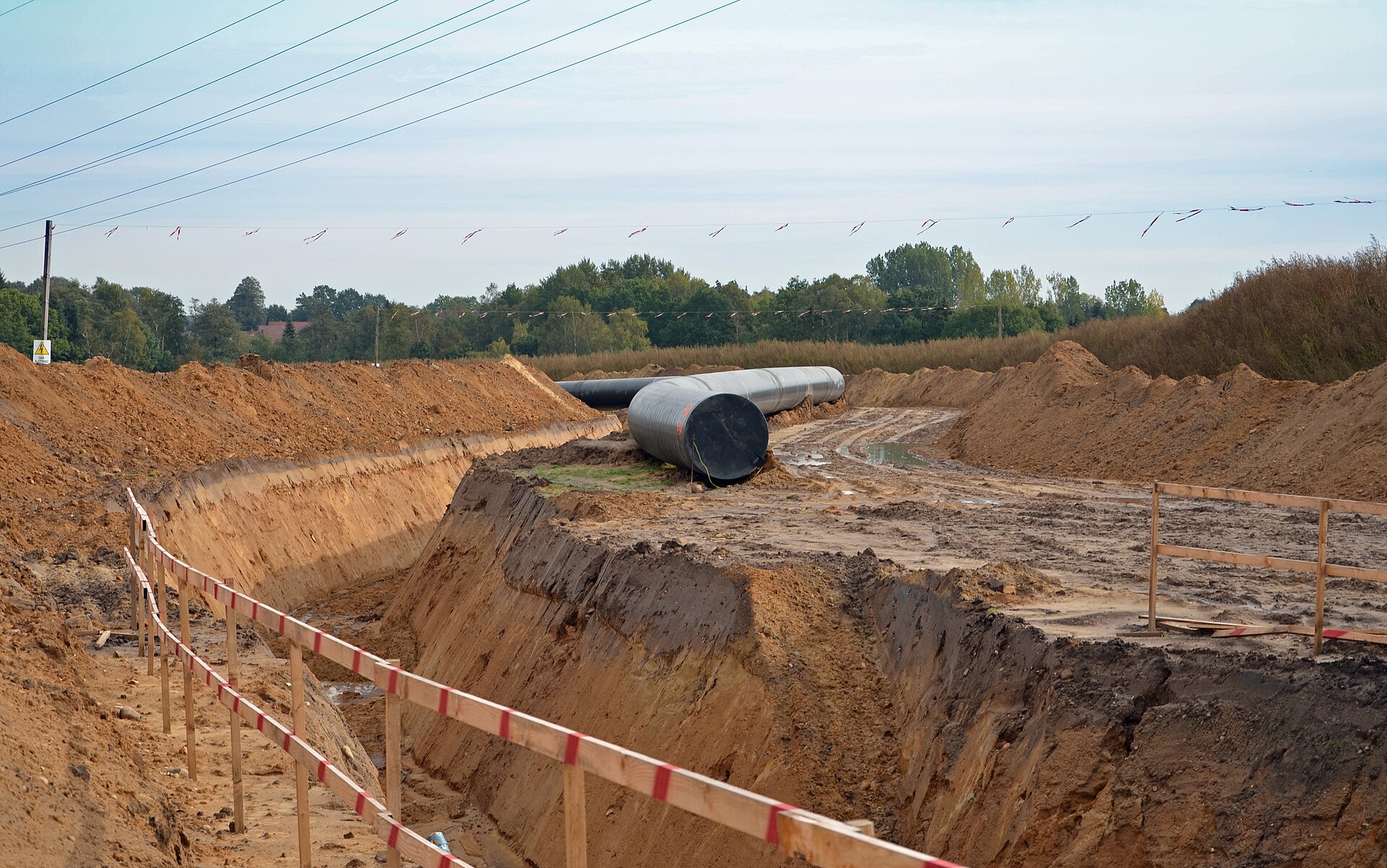
Image: Wikimedia Commons, Gaspipeline Bau.jpg (CC0).
Quick Answer: Dallas-based Atmos Energy reported fiscal 2026 earnings of $8.49 per diluted share on net income of about $1.4 billion, and invested $4.2 billion in its natural gas system, with more than 85 percent directed to safety and reliability. The company raised its indicated annual dividend 9 percent to $4.36 per share and guided fiscal 2027 earnings to a range of $9.05 to $9.25 per share on roughly $4.5 billion of capital spending.
What did Atmos Energy report for fiscal 2026?
Atmos Energy Corporation, the natural gas-only utility headquartered in Dallas, released results on November 4, 2026, for its fiscal year and fourth quarter ended September 30, 2026. Earnings per diluted share were $8.49 and net income was approximately $1.4 billion, according to the company’s earnings release filed with the Securities and Exchange Commission.
Analysis published by Zacks Equity Research the following day put the per-share increase at 13.8 percent from fiscal 2025 and described the result as the company’s 24th consecutive year of earnings growth. The company held its earnings call on November 5.
Atmos is one of the larger public companies based in Dallas and a member of the S&P 500. It delivers gas to about 3.4 million distribution customers in more than 1,400 communities across eight states, located primarily in the South, and it describes its pipeline and storage business as one of the largest intrastate natural gas pipeline systems in Texas.
| Headquarters | Dallas, Texas |
| Business | Regulated natural gas distribution; pipeline and storage |
| Distribution customers | About 3.4 million |
| Service area | More than 1,400 communities in eight states |
| Fiscal year end | September 30 |
| Fiscal 2026 diluted EPS | $8.49 |
| Fiscal 2026 net income | About $1.4 billion |
| Fiscal 2026 capital expenditures | $4.2 billion |
| Fiscal 2027 EPS guidance | $9.05 to $9.25 |
| Indicated fiscal 2027 dividend | $4.36 per share |
How did the fourth quarter compare with a year earlier?
The fiscal fourth quarter covers July through September, when heating demand is at its lowest, so it is the smallest earnings period of the year for a gas utility. Fourth-quarter earnings of $1.17 per share represented under 14 percent of the full-year total.
Even so, the quarter improved on every headline measure reported by Zacks. Diluted earnings per share rose to $1.17 from $1.07, a gain of 9.3 percent, and topped the Zacks consensus estimate of $1.14. Net income rose 13.7 percent to $199 million from $175 million. Operating income climbed 18.1 percent to $259.3 million from $219.5 million.
| Measure | Q4 FY2026 | Q4 FY2025 | Change |
|---|---|---|---|
| Diluted EPS | $1.17 | $1.07 | +9.3% |
| Net income | $199 million | $175 million | +13.7% |
| Operating income | $259.3 million | $219.5 million | +18.1% |
| Distribution net income | $72 million | $55 million | +30.9% |
| Pipeline and storage net income | $127 million | $120 million | +5.8% |
What drove the distribution segment?
The distribution segment is the local utility business: the mains, service lines and meters that deliver gas to homes and businesses. Its fourth-quarter net income rose 30.9 percent to $72 million from $55 million, and operating income increased to $86.4 million from $68.2 million.
Three items accounted for the improvement, according to the Zacks breakdown of the quarter. Rate adjustments contributed a net $37.3 million. Infrastructure-related cost deferrals, which allow a utility to defer certain costs tied to system investment until they are reflected in rates, added $13.5 million. Residential customer growth and higher industrial load added $7 million.
Working against those gains were $23.6 million of higher depreciation, amortization and property taxes, the natural consequence of a larger asset base, and $8.5 million of higher employee-related costs.
Why does customer growth matter for a Dallas utility?
A regulated utility earns its return on the capital it has invested to serve customers. When a service territory adds homes and industrial users, the cost of the system is spread over more meters and more volume. The $7 million quarterly contribution from residential growth and industrial load is small next to the rate adjustments, but it is the piece that comes from the underlying economy rather than from regulatory proceedings.
How did the pipeline and storage segment perform?
The pipeline and storage segment, which is concentrated in Texas, earned more than the distribution segment in the summer quarter. Net income rose 5.8 percent to $127 million from $120 million, and operating income increased to $172.9 million from $151.3 million.
Rate adjustments under the Gas Reliability Infrastructure Program that were approved in May 2026 contributed $27.6 million. Infrastructure-related cost deferrals added $7 million, and higher contracted capacity added $4.9 million. Those gains were partly offset by higher depreciation and property taxes and by lower through-system activity tied to narrower price spreads.
That last item is worth noting for anyone following the Texas gas market. Through-system revenue depends in part on the difference in gas prices between locations, and Atmos’ experience of narrower spreads in the quarter reduced that source of income even as its regulated rate revenue rose.
Where did the $4.2 billion in capital spending go?
Atmos reported capital expenditures of $4.2 billion for fiscal 2026, with more than 85 percent related to system safety and reliability. Zacks put the figure at $4.17 billion, up from $3.56 billion in fiscal 2025, an increase of roughly 17 percent, and said about 88 percent, or $3.67 billion, went to safety and reliability. Nearly $1.1 billion was spent in the fourth quarter alone.
To put the scale in perspective, capital spending was about three times the company’s net income for the year. That gap is why the financing plan discussed below matters as much as the income statement.
| Category | Amount |
|---|---|
| Transmission and distribution pipeline repair and replacement | $2.13 billion |
| Service line replacements | $499 million |
| System fortifications | $395 million |
| Measurement and regulating equipment | $314 million |
| Storage and compression | $210 million |
Pipe repair and replacement was by far the largest category at $2.13 billion, more than half of all capital spending. Service line replacements, the smaller lines running from the main to an individual customer, accounted for another $499 million.
How does Atmos recover that investment?
Through rates set by regulators. The company said it implemented $395.4 million in annualized regulatory outcomes during fiscal 2026. That figure represents the yearly revenue effect of rate decisions that took effect during the year, and it is the main reason both segments reported higher operating income despite rising depreciation and property taxes.
How is the company paying for the buildout?
With a mix of debt and equity designed to hold its balance sheet steady. Atmos reported that equity made up 60 percent of its capitalization as of September 30, 2026, and that it had $3.8 billion of available liquidity.
According to Zacks, the company issued $1.3 billion of long-term debt during the fiscal year: $600 million of 30-year senior notes in October 2025 and $700 million of five-year senior notes in June 2026. On the equity side, it settled $1.08 billion of equity forward agreements during the year and had $870.9 million still available under outstanding forward agreements at year end.
Equity forward agreements let a company lock in a share price in advance and receive the cash later, when it needs to fund construction. For a utility spending more than $4 billion a year, the approach matches the timing of share issuance to the timing of capital outlays.
| Measure | Figure |
|---|---|
| Equity capitalization, Sept. 30, 2026 | 60% |
| Available liquidity | $3.8 billion |
| Long-term debt issued in fiscal 2026 | $1.3 billion |
| Equity forward agreements settled | $1.08 billion |
| Remaining under forward agreements | $870.9 million |
| Annualized regulatory outcomes implemented | $395.4 million |
What is the dividend now?
The board declared a quarterly dividend of $1.09 per common share. The indicated annual dividend for fiscal 2027 is $4.36 per share, a 9.0 percent increase over fiscal 2026.
Measured against the midpoint of the company’s fiscal 2027 earnings guidance, $9.15 per share, the indicated dividend equals a little under 48 percent of expected earnings. The dividend increase of 9.0 percent is somewhat faster than the roughly 8 percent earnings growth implied by that guidance midpoint.
What does Atmos expect in fiscal 2027 and beyond?
The company initiated fiscal 2027 guidance of $9.05 to $9.25 in diluted earnings per share and capital expenditures of approximately $4.5 billion. The midpoint of the earnings range is about 7.8 percent above fiscal 2026’s $8.49. Zacks noted that its consensus estimate for fiscal 2027 stood at $9.05, the low end of the company’s range.
Zacks also reported the company’s net income guidance: $1.61 billion to $1.63 billion in total, with $1.03 billion to $1.04 billion from distribution and $580 million to $590 million from pipeline and storage. On those figures, the Texas-centered pipeline and storage business would provide a little more than a third of company earnings.
| Item | Guidance |
|---|---|
| Diluted EPS | $9.05 to $9.25 |
| Net income | $1.61 billion to $1.63 billion |
| Distribution net income | $1.03 billion to $1.04 billion |
| Pipeline and storage net income | $580 million to $590 million |
| Capital expenditures | About $4.5 billion |
| Capital plan through fiscal 2031 | Nearly $29 billion |
How large is the long-term plan?
Zacks reported that Atmos plans nearly $29 billion of capital investment through fiscal 2031. Spread across the five fiscal years from 2027 through 2031, that works out to an average of about $5.8 billion per year. Because fiscal 2027 is guided at roughly $4.5 billion, the arithmetic implies annual spending would have to rise well above the current level in the later years of the plan.
Why does this matter for the Dallas economy?
Three reasons stand out from the verified figures.
First, Atmos is a Dallas headquarters company whose spending is unusually steady. Its capital program rose from $3.56 billion to about $4.2 billion in one year and is guided higher again, and the bulk of it is pipe replacement and system hardening work that proceeds regardless of the business cycle.
Second, the company’s results are a read on regional growth. The distribution segment cited residential customer growth and higher industrial load as contributors to earnings, and the pipeline segment cited higher contracted capacity, meaning customers reserved more room on the system.
Third, the company itself flags its geographic concentration. The risk factors in its earnings release list the concentration of its operations in Texas. That concentration has been a strength while the state adds customers, and it also means Texas regulatory decisions carry outsized weight in the company’s results, as the $27.6 million quarterly contribution from a single Texas pipeline rate program shows.
What are the pressure points?
The fourth-quarter detail identifies them. Depreciation, amortization and property taxes rose $23.6 million in the distribution segment in a single quarter, and employee-related costs rose $8.5 million. Those costs grow with the asset base, so earnings growth depends on rate outcomes continuing to arrive on schedule. The company’s guidance assumes they will; the forward-looking statements in its release list regulatory, weather, financing and Texas-concentration risks among the factors that could change the outcome.
Frequently Asked Questions
What were Atmos Energy’s fiscal 2026 earnings?
Atmos reported earnings of $8.49 per diluted share and net income of about $1.4 billion for the fiscal year ended September 30, 2026.
Where is Atmos Energy headquartered?
Atmos Energy is headquartered in Dallas, Texas. It is an S&P 500 company serving about 3.4 million distribution customers in eight states.
How much did Atmos Energy spend on its system in fiscal 2026?
Capital expenditures totaled $4.2 billion, with more than 85 percent related to safety and reliability. The largest category was pipeline repair and replacement at $2.13 billion.
What is Atmos Energy’s dividend?
The board declared a quarterly dividend of $1.09 per share. The indicated annual dividend for fiscal 2027 is $4.36, up 9.0 percent.
What is Atmos Energy’s fiscal 2027 guidance?
The company guided to diluted earnings of $9.05 to $9.25 per share and capital spending of approximately $4.5 billion.
How much does Atmos plan to invest over the next five years?
Zacks reported a plan of nearly $29 billion in capital investment through fiscal 2031.
Sources and Further Reading
- Atmos Energy Corporation Reports Earnings for Fiscal 2026; Initiates Fiscal 2027 Guidance, Form 8-K Exhibit 99.1 – U.S. Securities and Exchange Commission
- Atmos Energy Corporation Reports Earnings for Fiscal 2026; Initiates Fiscal 2027 Guidance – Business Wire via Finviz
- Atmos Energy Q4 Earnings Beat on Rate Gains and Operating Strength – Zacks Equity Research