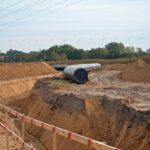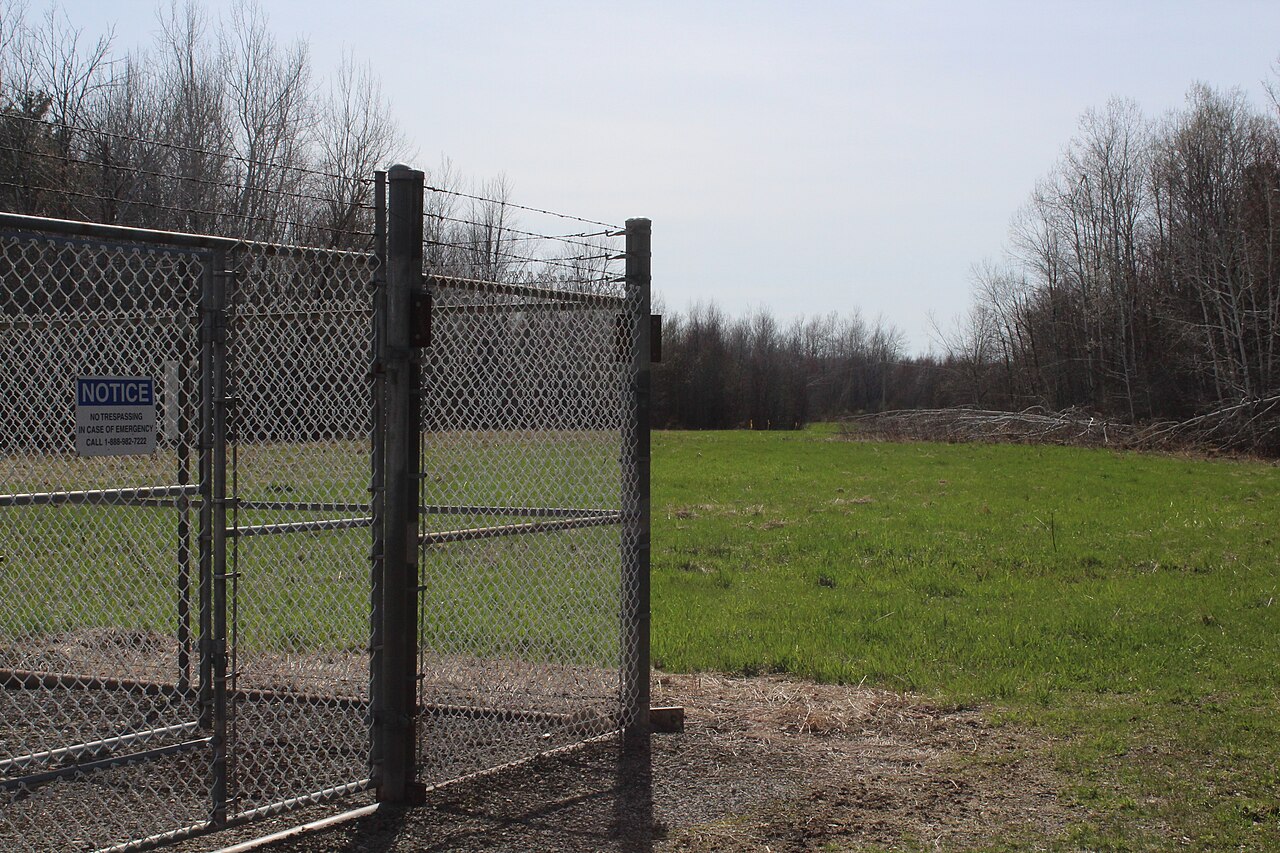
A buried natural gas pipeline right-of-way with fenced aboveground equipment. Photo: NewFearOC, Wikimedia Commons. License: CC0 1.0 public domain dedication.
Quick Answer: Dallas-based Energy Transfer reported third-quarter 2026 Adjusted EBITDA of $5.03 billion, up 31% from a year earlier, and net income attributable to partners of $1.21 billion. The pipeline operator raised its full-year Adjusted EBITDA guidance to a range of $19.7 billion to $19.9 billion and said it expects to spend about $7 billion on growth projects in 2027.
Energy Transfer LP, one of the largest companies headquartered in Dallas, released results on November 3, 2026 for the quarter ended September 30. The numbers show a partnership growing on two fronts at once: record volumes on its own Texas pipelines and processing plants, and a much larger contribution from Sunoco LP, the fuel distributor it controls. This article breaks down the quarter using the partnership’s earnings release and an analysis of the earnings call published by RBN Energy. All figures are as of the release date unless noted.
What did Energy Transfer report for the third quarter of 2026?
Net income attributable to partners rose to $1.21 billion from $1.02 billion in the third quarter of 2025, an increase of about 18%. Earnings per common unit were $0.33, up from $0.28. Consolidated Adjusted EBITDA, the measure the partnership and its lenders watch most closely, reached $5.03 billion against $3.84 billion a year earlier. Distributable cash flow attributable to partners, as adjusted, was $2.52 billion, up 33% from $1.90 billion.
Revenue climbed to $37.10 billion from $19.95 billion, a gain of roughly 86%. Revenue at a pipeline company is heavily influenced by commodity prices and by the consolidation of acquired businesses, which is why management and analysts focus on EBITDA and cash flow instead.
| Metric | Q3 2026 | Q3 2025 | Change |
|---|---|---|---|
| Revenues | $37.10 billion | $19.95 billion | +86% |
| Net income attributable to partners | $1.21 billion | $1.02 billion | +18% |
| Net income per common unit | $0.33 | $0.28 | +$0.05 |
| Adjusted EBITDA | $5.03 billion | $3.84 billion | +31% |
| Distributable cash flow, as adjusted | $2.52 billion | $1.90 billion | +33% |
| Quarterly distribution per unit | $0.3425 | Not stated | More than 3% higher |
How do the first nine months compare?
Through September 30, revenues totaled $99.21 billion, compared with $60.22 billion in the same period of 2025. Net income attributable to partners was $4.55 billion, up from $3.51 billion. Adjusted EBITDA reached $15.03 billion, about 27% above the $11.80 billion earned in the first nine months of 2025, and distributable cash flow as adjusted was $7.81 billion against $6.16 billion.
Which businesses drove the growth?
Every operating segment earned more than it did a year earlier. The largest single contributor was the partnership’s investment in Sunoco LP, where Adjusted EBITDA more than doubled to $1.05 billion from $489 million. That $560 million gain accounted for about 47% of the consolidated increase, a share RBN Energy also highlighted in its review of the quarter. Energy Transfer’s release ties the Sunoco and crude oil gains to recent acquisitions and to crude marketing. RBN noted that Sunoco’s purchase of Parkland, which closed in October 2025, brought with it a refinery in Burnaby, British Columbia.
The core pipeline businesses also expanded. The natural gas liquids and refined products segment, the partnership’s largest, earned $1.22 billion, up $170 million. Crude oil transportation and services earned $871 million, up $125 million. Midstream, which gathers and processes natural gas, earned $864 million, up $113 million. Interstate natural gas transportation and storage rose to $500 million from $431 million.
| Segment Adjusted EBITDA | Q3 2026 | Q3 2025 | Change |
|---|---|---|---|
| NGL and refined products | $1,224 million | $1,054 million | +$170 million |
| Investment in Sunoco LP | $1,049 million | $489 million | +$560 million |
| Crude oil transportation and services | $871 million | $746 million | +$125 million |
| Midstream | $864 million | $751 million | +$113 million |
| Interstate transportation and storage | $500 million | $431 million | +$69 million |
| Intrastate transportation and storage | $346 million | $230 million | +$116 million |
| Investment in USA Compression | $198 million | $160 million | +$38 million |
| All other | ($21) million | ($23) million | +$2 million |
Why did the Texas intrastate business jump 50%?
The fastest-growing pipeline segment in percentage terms was intrastate transportation and storage, where Adjusted EBITDA rose about 50% to $346 million. Intrastate natural gas transportation volumes increased 14% to 15,759 billion British thermal units per day, which the partnership called a new record. The release attributes the higher volumes on its Texas intrastate pipelines to new contracts tied to the Hugh Brinson Pipeline and the assets downstream of it.
Hugh Brinson is the partnership’s newest large-diameter gas line. The release says Phase I was placed into full service on September 1, 2026, ahead of schedule, that Phase II remains on schedule for the first quarter of 2027, and that the full project is expected to come in under budget. According to RBN Energy, Phase I reached 1.5 billion cubic feet per day on September 1 and Phase II will add more than 800 million cubic feet per day.
What volume records did the partnership set?
Midstream gathered volumes rose 6% to 22,941 billion British thermal units per day, also a partnership record, and natural gas liquids produced at its plants increased to 1.27 million barrels per day from 1.15 million. NGL transportation volumes grew 6% to 2.63 million barrels per day, NGL exports rose 9% and fractionation volumes rose 5% to 1.18 million barrels per day. Crude oil transportation was up about 1% at 7.11 million barrels per day, with the release citing growth on its Texas pipeline system.
Not every line moved higher. Refined products transportation fell to 539,000 barrels per day from 601,000, a decline of about 10% that RBN attributed to issues at third-party refineries. Crude terminal volumes slipped to 4.17 million barrels per day from 4.26 million.
How much is Energy Transfer raising its outlook?
The partnership now expects full-year 2026 Adjusted EBITDA of $19.7 billion to $19.9 billion. The previous range was $18.8 billion to $19.1 billion, so the midpoint moved up by $850 million. With $15.03 billion earned through nine months, the new range implies a fourth quarter of roughly $4.7 billion to $4.9 billion.
Capital spending is heading higher as well. Energy Transfer spent $1.30 billion on growth projects in the third quarter and expects 2026 growth capital of $5.4 billion to $5.6 billion. For 2027 it expects to spend approximately $7 billion on growth, an increase of more than a quarter from the midpoint of this year’s range.
What is in the project pipeline?
Much of the spending is concentrated in Texas, particularly the Permian Basin and the Gulf Coast. The release and the RBN analysis describe the following projects:
| Project | Details | Timing |
|---|---|---|
| Hugh Brinson Pipeline, Phase II | More than 800 million cubic feet per day (RBN) | First quarter 2027 |
| Mustang Draw II processing plant | 275 million cubic feet per day, Midland Basin | In service October 2026 |
| Bear II cryogenic plant | 200 million cubic feet per day, Delaware Basin | Third quarter 2027 |
| Frac X at Mont Belvieu | 200,000 barrels per day, tenth fractionator | First half of 2029 |
| South Mississippi Pipeline | 215 miles, 1.2 billion cubic feet per day, about $1.6 billion | Projected 2030 |
| Vaquero Midstream acquisition | Approximately $2.6 billion in cash and equity | Expected to close Q4 2026 |
Mustang Draw II entered service in October in the Midland Basin, following Mustang Draw I, which RBN says started up in June. Bear II, announced in November, will sit beside the existing Bear plant in the Delaware Basin. Frac X, also announced in November, will be the tenth fractionator at the partnership’s Mont Belvieu complex east of Houston. RBN reports that the ninth, a 165,000 barrel-per-day unit, is due in service in the fourth quarter of 2026.
The Vaquero Midstream purchase, announced in October for approximately $2.6 billion including cash and equity, is described as a bolt-on and remains subject to regulatory approval. RBN’s account says the deal adds 675 million cubic feet per day of Permian gas processing capacity and about 300 miles of pipeline within the basin.
Outside Texas, the partnership reached a final investment decision in November on the South Mississippi Pipeline, a 215-mile, 36-inch line with 1.2 billion cubic feet per day of capacity. Energy Transfer expects to own 51% and operate it. The release also describes a 15-year agreement on the Rover Pipeline for 250,000 million British thermal units per day of firm capacity with a Marcellus producer, and two agreements on the MRT Pipeline to deliver 150,000 million British thermal units per day to two power plants under construction in Missouri, with service beginning in late 2027 and mid-2028. On exports, RBN reports that an ethane export expansion at Nederland on the Texas coast was upsized to 300,000 barrels per day from 240,000, with a phased startup from 2028 to mid-2029.
What does the quarter mean for unitholders?
Energy Transfer declared a distribution of $0.3425 per common unit for the quarter, or $1.37 on an annualized basis. The partnership said that is more than 3% above the distribution for the third quarter of 2025 and marks its twentieth consecutive quarterly increase. Distributions to limited partners totaled $1.18 billion in the quarter, against $2.52 billion of distributable cash flow, which means the partnership generated a little more than twice the cash it paid out. The remainder helps fund the growth program.
How strong is the balance sheet?
At September 30, 2026, Energy Transfer had $4.41 billion available under its $5 billion revolving credit facility, which matures in April 2029. Long-term debt, less current maturities, stood at $68.84 billion, compared with $68.31 billion at the end of 2025. Total assets were $149.39 billion. In August the partnership redeemed $900 million of its 6.500% Series H perpetual preferred units, funding the redemption with an offering of junior subordinated notes.
How large is Energy Transfer’s footprint?
The partnership describes its network as approximately 140,000 miles of pipeline and associated energy infrastructure in 44 states. It also holds the general partner interests in two other publicly traded partnerships. It owns about 28 million common units of Sunoco LP, a stake of roughly 15%, and about 46 million units of USA Compression Partners, or roughly 32%. Sunoco’s system includes about 14,000 miles of pipeline, more than 170 terminals and about 11,000 retail locations across 33 countries and territories, and it distributes more than 17 billion gallons of fuel a year. The earnings release lists the partnership’s ticker as TXSE: ET.
| Company snapshot | Figure |
|---|---|
| Headquarters | Dallas, Texas |
| Pipeline and infrastructure network | About 140,000 miles in 44 states |
| 2026 Adjusted EBITDA guidance | $19.7 billion to $19.9 billion |
| 2026 growth capital guidance | $5.4 billion to $5.6 billion |
| 2027 growth capital expectation | Approximately $7 billion |
| Annualized distribution | $1.37 per unit |
| Long-term debt, less current maturities | $68.84 billion |
| Revolver availability | $4.41 billion |
Brian’s Take
What stands out to me in this report is the mix. Nearly half of the EBITDA increase came from Sunoco, and that is acquisition-driven growth. I pay more attention to the other half. Record intrastate and gathering volumes, a 50% jump in the Texas intrastate segment and a new pipeline that went into service early are the kind of results that come from assets in the ground doing more work.
The spending plan is the part I would keep an eye on. Going from about $5.5 billion of growth capital this year to roughly $7 billion next year is a big step for a partnership already carrying close to $69 billion of long-term debt. The cash coverage of the distribution, a little over two times this quarter, gives management room to do it, but large projects have to arrive on time and on budget for the math to keep working. Hugh Brinson is a good early data point on that score.
For Dallas and for Texas, the takeaway is simpler. The processing plants, fractionators and export docks on this list are mostly being built in this state, and they are being built because Permian production keeps needing a way to market.
Frequently Asked Questions
What was Energy Transfer’s Adjusted EBITDA in the third quarter of 2026?
Adjusted EBITDA was $5.03 billion, up 31% from $3.84 billion in the third quarter of 2025.
What is Energy Transfer’s 2026 guidance?
The partnership expects full-year Adjusted EBITDA of $19.7 billion to $19.9 billion, raised from $18.8 billion to $19.1 billion, and growth capital spending of $5.4 billion to $5.6 billion.
What is Energy Transfer’s current distribution?
The quarterly distribution is $0.3425 per common unit, or $1.37 annualized, the twentieth consecutive quarterly increase.
What is the Hugh Brinson Pipeline?
It is a natural gas pipeline whose first phase entered full service on September 1, 2026. Phase II is scheduled for the first quarter of 2027, and the project is expected to finish under budget.
What is Energy Transfer buying?
In October 2026 it announced the acquisition of Vaquero Midstream for approximately $2.6 billion in cash and equity. The deal is expected to close in the fourth quarter, subject to regulatory approval.
Where is Energy Transfer headquartered?
Energy Transfer is based in Dallas and operates approximately 140,000 miles of pipeline and related infrastructure in 44 states.
Sources and Further Reading
- Energy Transfer Reports Third Quarter 2026 Results (Form 8-K, Exhibit 99.1) – Energy Transfer LP, U.S. Securities and Exchange Commission
- Q3 2026 Earnings Calls: Energy Transfer analyst insight – RBN Energy
- Energy Transfer Reports Second Quarter 2026 Results – Energy Transfer LP