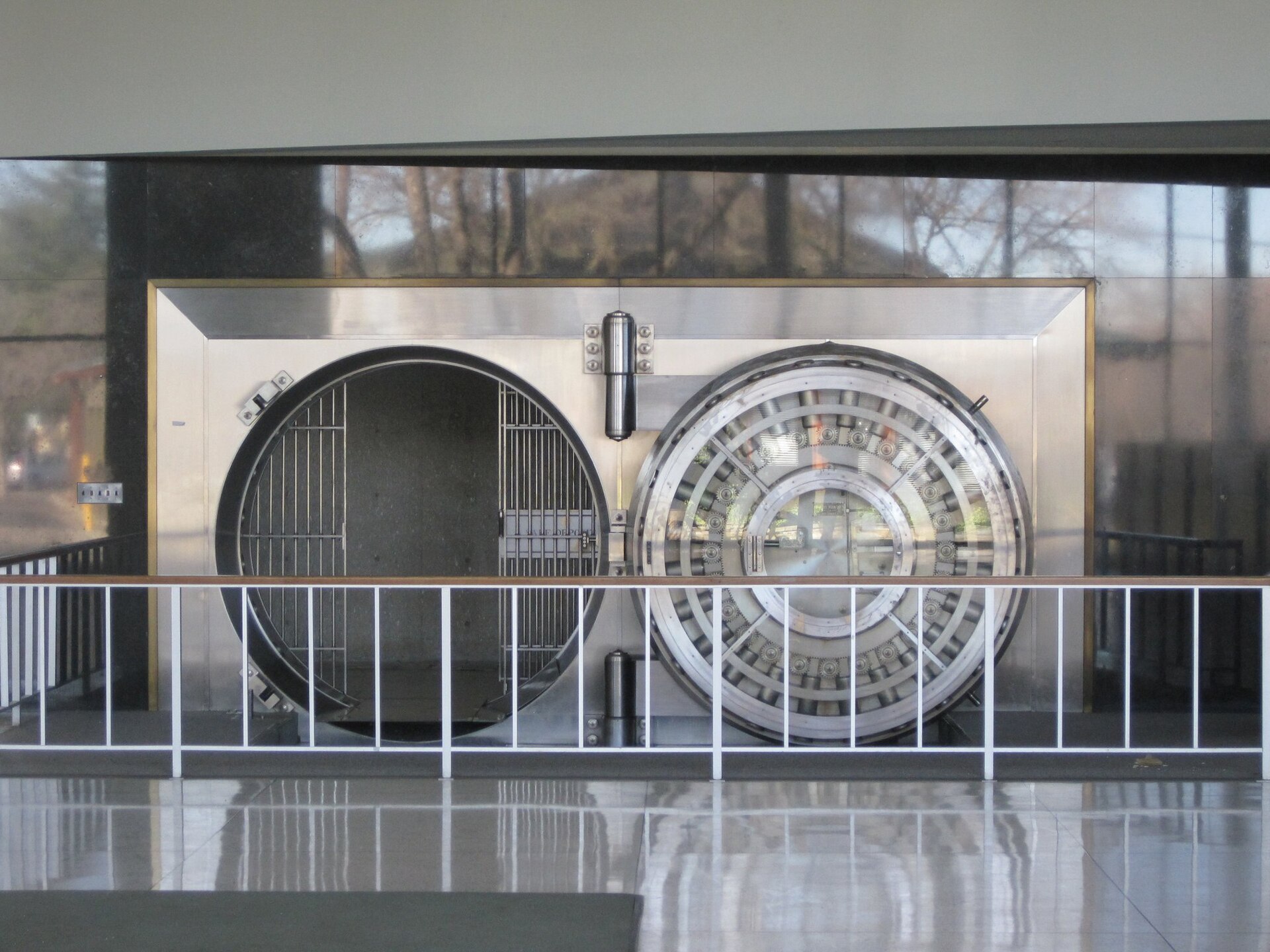
Photo: John McGehjee via Wikimedia Commons, CC0 public domain dedication
Quick Answer: Texas Capital Bancshares, the Dallas-based parent of Texas Capital Bank, earned $99.4 million for common stockholders, or $2.28 per diluted share, in the third quarter of 2026 on total revenue of $356.6 million. The company described both its $275.0 million of net interest income and its fee income as record-level, but criticized loans climbed to $782.4 million and its mortgage finance loan book shrank about 15% in three months.
The results, released October 21, 2026, cover the three months ended September 30, 2026. They arrived in the middle of a busy autumn for the company: it moved its primary stock listing from Nasdaq to the Texas Stock Exchange on October 8 and began trading under a new ticker symbol, TXCP, on November 9. This article walks through the numbers in the company’s earnings release as filed with the Securities and Exchange Commission, with all figures stated as of November 26, 2026.
What did Texas Capital report for the third quarter of 2026?
Texas Capital reported net income of $103.7 million for the quarter, which works out to $99.4 million available to common stockholders after $4.3 million of preferred stock dividends. Diluted earnings per common share were $2.28, up from $1.83 in the second quarter of 2026 and $2.18 in the third quarter of 2025.
Total revenue, which the company defines as net interest income plus non-interest income, reached $356.6 million. That was 4.8% above the $340.4 million posted a year earlier and 6.3% above the $335.5 million recorded in the second quarter. Pre-provision net revenue, a measure of earnings before credit costs and taxes, was $152.7 million, compared with $149.8 million a year earlier.
| Key fact | Third quarter 2026 |
|---|---|
| Headquarters | Dallas, Texas |
| Total revenue | $356.6 million |
| Net interest income | $275.0 million |
| Non-interest income | $81.6 million |
| Net income available to common | $99.4 million |
| Diluted earnings per share | $2.28 ($2.35 adjusted) |
| Net interest margin | 3.44% |
| Total assets (September 30) | $32.3 billion |
| Total deposits (September 30) | $27.7 billion |
| Common Equity Tier 1 ratio | 12.2% |
| Criticized loans (September 30) | $782.4 million |
| Stock listing | Texas Stock Exchange, ticker TXCP |
How does the quarter compare with the previous four?
The third quarter was the strongest of 2026 on nearly every income measure, and it capped a steady climb from a soft start to the year. Net income available to common stockholders rose from $69.5 million in the first quarter to $80.6 million in the second and $99.4 million in the third. The efficiency ratio, which measures expenses against revenue and improves as it falls, moved from 65.9% in the first quarter to 57.2% in the third.
| Measure | Q3 2025 | Q4 2025 | Q1 2026 | Q2 2026 | Q3 2026 |
|---|---|---|---|---|---|
| Total revenue ($M) | 340.4 | 327.5 | 324.0 | 335.5 | 356.6 |
| Net interest income ($M) | 271.8 | 267.4 | 254.7 | 260.4 | 275.0 |
| Non-interest income ($M) | 68.6 | 60.0 | 69.3 | 75.1 | 81.6 |
| Non-interest expense ($M) | 190.6 | 184.2 | 213.6 | 205.5 | 203.9 |
| Provision for credit losses ($M) | 12.0 | 11.0 | 16.0 | 18.0 | 17.0 |
| Net income to common ($M) | 100.9 | 96.3 | 69.5 | 80.6 | 99.4 |
| Diluted EPS | $2.18 | $2.12 | $1.56 | $1.83 | $2.28 |
| Net interest margin | 3.47% | 3.38% | 3.43% | 3.28% | 3.44% |
| Efficiency ratio | 56.0% | 56.2% | 65.9% | 61.3% | 57.2% |
Through the first nine months of 2026, net income available to common stockholders totaled $249.5 million, up 15.2% from $216.6 million in the same period of 2025. Diluted earnings per share for the nine months were $5.66, compared with $4.67, and combined net interest and non-interest income came to roughly $1.02 billion, about 9.5% more than a year earlier.
Why did earnings per share rise when net income slipped from a year ago?
Earnings per share rose because the company has far fewer shares outstanding than it did a year ago. Net income available to common stockholders was actually 1.5% lower than the $100.9 million earned in the third quarter of 2025, largely because the provision for credit losses was $5.0 million higher and non-interest expense was $13.3 million higher. Yet the diluted share count used in the calculation fell to 43.6 million from 46.2 million, lifting per-share earnings 4.6%.
Where is Texas Capital’s revenue growth coming from?
Most of the year-over-year growth came from fees rather than lending. Non-interest income rose 19.0% from the third quarter of 2025, to $81.6 million, while net interest income rose 1.2%. Non-interest income made up 22.9% of total revenue in the quarter, up from 20.2% a year earlier.
The company’s headline claim of fee income up 14% refers to a narrower group of four lines: service charges on deposit accounts, wealth management and trust fees, investment banking and advisory fees, and trading income. Those four totaled $60.7 million, against $53.3 million a year earlier. Investment banking and trading together produced $46.7 million.
| Non-interest income line | Q3 2025 ($M) | Q3 2026 ($M) | Change |
|---|---|---|---|
| Investment banking and advisory fees | 34.0 | 35.3 | +3.9% |
| Trading income | 7.2 | 11.4 | +57.7% |
| Service charges on deposit accounts | 8.1 | 9.4 | +16.1% |
| Wealth management and trust fees | 4.0 | 4.6 | +14.4% |
| Brokered loan fees | 2.4 | 2.1 | -14.2% |
| Other | 12.8 | 18.9 | +47.0% |
| Total non-interest income | 68.6 | 81.6 | +19.0% |
The nine-month picture shows the shift more clearly. Investment banking and advisory fees totaled $98.8 million for the first three quarters of 2026, up 32.5% from $74.6 million in the same period of 2025. Trading income rose to $33.0 million from $21.1 million. Total non-interest income for the nine months was $226.0 million, 35.3% above the prior-year period, which had included a $1.9 million loss on securities sales.
What happened to the net interest margin?
The net interest margin rebounded to 3.44%, up 16 basis points from 3.28% in the second quarter, though still 3 basis points below the 3.47% of a year earlier. The company attributed the quarterly gain mainly to higher yields on earning assets and lower short-term and long-term borrowings, partly offset by higher funding costs.
The average yield on loans held for investment, excluding mortgage finance, was 6.76% in the quarter, compared with 6.62% in the second quarter and 6.95% a year earlier. The total cost of deposits was 2.45%, up 5 basis points from the second quarter and down 17 basis points from the third quarter of 2025. Average earning assets were $31.8 billion, about 2.4% higher than a year earlier, and total interest expense fell to $182.2 million from $188.8 million.
What is happening on the balance sheet?
The balance sheet got smaller during the quarter, mostly because of a pullback in mortgage finance. Total assets were $32.3 billion on September 30, 2026, down 4.6% from $33.9 billion on June 30 and slightly below the $32.5 billion of a year earlier.
Texas Capital reports its loans in two groups. Loans held for investment excluding mortgage finance, the core commercial book, were $18.6 billion at quarter end, up 2.8% from $18.1 billion a year earlier. Mortgage finance loans, which fund mortgage originators and move with home lending volumes, fell to $5.4 billion from $6.4 billion at June 30, a 14.8% drop in three months, and were 10.2% lower than a year earlier.
Total deposits were $27.7 billion, down 4.1% from $28.9 billion at June 30 but 0.8% higher than a year earlier. Non-interest bearing deposits were $7.0 billion, about a quarter of the total. The company ended the quarter with no short-term borrowings, compared with $350.0 million at June 30, and long-term debt of $487.3 million, down from $620.4 million a year earlier.
Is credit quality getting worse?
Early-warning measures have weakened over the past year, while actual losses have stayed in a narrow range. Criticized loans, the bank’s category for credits showing signs of stress, reached $782.4 million on September 30, 2026. That was up from $696.3 million three months earlier and $529.7 million a year earlier, an increase of about 48% in twelve months. Criticized loans equaled 3.25% of total loans held for investment, compared with 2.19% a year earlier.
| Credit measure | Q3 2025 | Q2 2026 | Q3 2026 |
|---|---|---|---|
| Criticized loans ($M) | 529.7 | 696.3 | 782.4 |
| Special mention loans ($M) | 249.6 | 479.3 | 526.3 |
| Non-accrual loans held for investment ($M) | 96.1 | 124.0 | 122.3 |
| Non-accrual share of loans | 0.40% | 0.50% | 0.51% |
| Loans 90 days past due, still accruing ($M) | 0.1 | 0.5 | 53.2 |
| Net charge-offs ($M) | 13.7 | 16.1 | 14.5 |
| Net charge-offs to average loans (annualized) | 0.23% | 0.26% | 0.24% |
| Total allowance to loans held for investment | 1.37% | 1.34% | 1.39% |
Realized losses were steadier. Net charge-offs were $14.5 million, all from the commercial category, compared with $16.1 million in the second quarter and $13.7 million a year earlier. The company recorded a $17.0 million provision for credit losses, which it tied mainly to the rise in criticized loans and the quarter’s charge-offs. The total allowance for credit losses stood at $335.8 million, or 1.39% of loans held for investment, and covered non-accrual loans 2.7 times.
How strong is the bank’s capital, and what is it returning to shareholders?
Texas Capital’s regulatory capital ratios remained above the levels required to be considered well capitalized as of September 30, 2026, according to the company. The Common Equity Tier 1 ratio was 12.2%, the Tier 1 capital ratio 13.7%, the total capital ratio 14.8% and the leverage ratio 11.7%. The total capital ratio was 16.1% a year earlier. Tangible common equity equaled 9.9% of tangible assets.
During the third quarter the company repurchased 1,051,660 common shares for $103.0 million, including excise tax, at a weighted average price of $96.99 per share. Effective October 20, 2026, the board authorized a new program allowing up to $200.0 million of repurchases through October 31, 2027, and ended what remained of the program approved on December 12, 2025.
The board also declared a cash dividend of $0.20 per common share and a dividend on the Series B preferred stock equal to $0.359375 per depositary share. Both are payable December 15, 2026, to holders of record at the close of business on December 1, 2026.
What has management said about the rest of 2026?
Management raised parts of its full-year outlook on the earnings call, according to the Earnings Whispers review, which is a secondary account of the call. That review reported full-year revenue growth guidance of high single digits, a fee income outlook of $295 million to $300 million, up from a prior range of $270 million to $290 million, and expense growth in the mid-to-high single digits.
For the fourth quarter, the same review reported guidance for a net interest margin of 3.45% to 3.50%, net interest income of $270 million to $275 million and fee income of $70 million to $75 million, which would be below the third quarter’s level. These are forward-looking statements from management, not results, and actual figures may differ.
Why did Texas Capital move its stock to the Texas Stock Exchange?
The company presented the move as a way to align a Texas-founded, Texas-headquartered firm with a Texas-based exchange. On September 14, 2026, Texas Capital Bancshares announced it would transfer the primary listing of its common stock and its 5.75% Series B preferred stock from Nasdaq to the Texas Stock Exchange. The company said it had been an early supporter of the exchange.
The transfer followed the announced timetable. The shares traded on Nasdaq through the close on October 7, 2026, and began trading on the Texas Stock Exchange on October 8 under the existing TCBI symbol. On November 9, 2026, the company announced that its common and preferred ticker symbols had changed to TXCP and TXCP PRB, effective at the market open, and said it would mark the change with a closing bell ceremony in Dallas that day. No action was required from stockholders at either step.
What does the quarter say about Dallas banking?
The results show a Dallas-headquartered bank earning a growing share of its revenue from capital markets activity rather than from lending alone. Texas Capital was founded in 1998, is a member of the S&P MidCap 400 and, according to its September announcement, has offices in Austin, Fort Worth, Houston, San Antonio, Chicago, Los Angeles and New York City in addition to its Dallas base. Its commercial loan book grew 2.8% over the year, while investment banking, trading and other fee lines grew much faster.
Frequently Asked Questions
How much did Texas Capital earn in the third quarter of 2026?
It earned $99.4 million available to common stockholders, or $2.28 per diluted share, for the three months ended September 30, 2026. Adjusted for $4.3 million of restructuring expenses, the figures were $102.7 million and $2.35 per share.
What is Texas Capital’s ticker symbol now?
The common stock trades on the Texas Stock Exchange under the symbol TXCP as of November 9, 2026. It previously traded as TCBI, on Nasdaq through October 7, 2026 and on the Texas Stock Exchange from October 8.
Does Texas Capital pay a dividend?
Yes. The board declared a cash dividend of $0.20 per common share, payable December 15, 2026, to holders of record on December 1, 2026.
What are criticized loans, and how many does the bank have?
Criticized loans are credits a bank has flagged as showing potential or actual weakness. Texas Capital reported $782.4 million of them on September 30, 2026, equal to 3.25% of total loans held for investment, up from $529.7 million a year earlier.
Sources and Further Reading
- Texas Capital Bancshares, Inc. Announces Third Quarter 2026 Results (Form 8-K, Exhibit 99.1, October 21, 2026), Texas Capital Bancshares via U.S. Securities and Exchange Commission
- Texas Capital to Bring Corporate Listing Home to the Texas Stock Exchange (Form 8-K, Exhibit 99.1, September 14, 2026), Texas Capital Bancshares via U.S. Securities and Exchange Commission
- Texas Capital Bancshares, Inc. Begins Trading on TXSE Under New TXCP Ticker (November 9, 2026), Texas Capital Bancshares via GlobeNewswire
- Texas Capital Beats And Raises On Fee Momentum, But Credit Migration And A Shrinking Mortgage Book Complicate The Record Quarter (October 21, 2026), Earnings Whispers