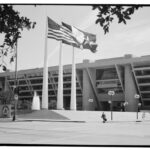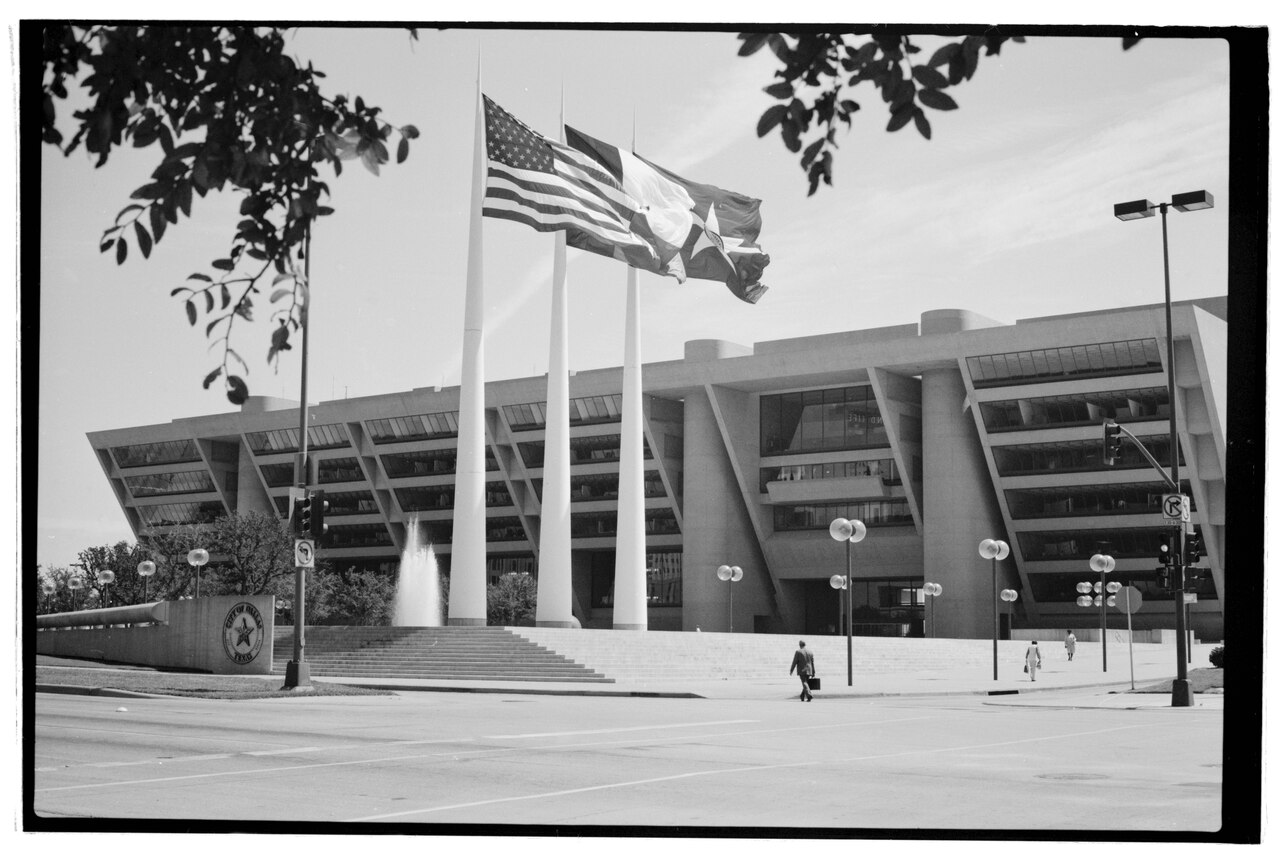
Dallas City Hall, main elevation. Photo: Historic American Buildings Survey, Library of Congress, public domain.
Quick Answer: The Dallas City Council adopted a $5.66 billion operating and capital budget for fiscal year 2026-27 on September 16, 2026, up from $5.20 billion a year earlier. The property tax rate fell to 69.78 cents per $100 of valuation, the 11th straight annual cut, while nearly all new General Fund money went to police and fire.
Dallas began its new fiscal year on October 1, 2026, with the largest budget in city history, a slightly lower property tax rate and a spending plan that leans heavily toward public safety. The plan closed a projected shortfall in part by eliminating nearly 300 positions, and it commits the city to adding 750 police officers over two years. The figures below come from City of Dallas budget documents and news releases and are stated as of November 26, 2026.
How big is the Dallas city budget for fiscal 2026-27?
The adopted operating and capital budget totals $5.66 billion for the year running October 1, 2026, through September 30, 2027. That figure covers the General Fund, enterprise funds, debt service, capital projects, grants, trusts and other funds. The prior year’s total was $5.20 billion, so the new budget is about $460 million, or roughly 8.8%, larger.
The appropriations ordinance carries a higher total of $5.98 billion, because it also counts internal service funds and the Employee Retirement Fund, which is budgeted at $318.7 million and accounted for separately.
The General Fund, which pays for day-to-day services such as police, fire, parks, libraries and code enforcement, was adopted at $2.05 billion. The city says that is $83 million, or 4.2%, above the General Fund adopted in September 2025.
| Measure | FY 2025-26 | FY 2026-27 adopted | Change |
|---|---|---|---|
| Total operating and capital budget | $5.20 billion | $5.66 billion | About +8.8% |
| General Fund | About $1.97 billion | $2.05 billion | +$83 million (+4.2%) |
| Property tax rate per $100 | 69.88 cents | 69.78 cents | -0.10 cent |
| Street lane miles improved | 759 | 800 | +41 |
Prior-year General Fund is derived from the city’s stated increase. Source: City of Dallas.
The adopted General Fund is slightly larger than the version the city manager proposed in August, which stood at $2.04 billion, an increase of $80.2 million or 4.1%. The difference reflects additions the council made for libraries, pools and recreation centers. The ordinance text reviewed for this article lists a General Fund total of about $2.04 billion, so department line items should be read as close to, but not necessarily identical to, the final figures.
When was the budget adopted?
City Manager Kimberly Bizor Tolbert released a proposed two-year budget covering fiscal 2026-27 and fiscal 2027-28 on August 7, 2026, under the theme “Investing for the Future,” and formally presented it to the council on August 11. Council members held 25 budget town halls, concluding August 25. The appropriations ordinance passed on first reading September 2 and on second reading September 16, when the council completed adoption of the operating, capital and grants and trusts budgets.
What is the Dallas property tax rate for 2026-27?
The adopted rate is 69.78 cents per $100 of taxable valuation, down from 69.88 cents. The city counts it as the 11th consecutive annual reduction. Since fiscal 2015-16, the rate has fallen by 9.92 cents, or 12.44%, according to the city’s August release.
How much does the rate cut save a property owner?
Very little on its own. A reduction of one-tenth of a cent per $100 equals $1 for every $100,000 of taxable value. As an illustration, a home appraised at $400,000 with the city’s 20% homestead exemption would have $320,000 in taxable value and would save about $3.20 a year from the rate change, on a city tax bill of roughly $2,233. A commercial property with $10 million in taxable value would save about $100.
Actual bills depend far more on appraised values, which are set by the appraisal districts and can rise even when the rate falls. Dallas spans four of them. The budget caps the city’s payments to the Dallas, Collin, Denton and Rockwall appraisal districts at $6.8 million.
What exemptions does Dallas offer?
The city offers a 20% homestead exemption and a $175,000 exemption for residents who are 65 or older or have a disability. Combined, the city says a qualifying senior or disabled homeowner with a home valued at $218,750 or less owes no city property tax. The math is simple: the 20% exemption removes $43,750 of value, and the $175,000 exemption covers the rest.
How much is Dallas spending on police and fire?
Public safety is the center of the budget. The combined Dallas Police Department and Dallas Fire-Rescue budgets rise by $82.3 million, which is nearly the entire $83 million increase in the General Fund. The city said at the time of the proposal that nearly all General Fund growth goes to the two departments.
The appropriations ordinance sets the Police Department’s General Fund appropriation at $823.8 million and Dallas Fire-Rescue’s at $471.0 million. Together that is about $1.29 billion, or roughly 63% of the General Fund shown in the ordinance.
How many police officers does Dallas plan to hire?
The two-year plan calls for adding 750 officers, reaching 3,651 sworn officers by the end of fiscal 2026-27 and 3,800 by the end of fiscal 2027-28. Starting pay for a police officer is $83,822, and the budget includes market-based pay and step increases for both police and fire personnel. The proposal also cited body cameras with artificial intelligence features and drones used as first responders as efficiency measures, without attaching dollar figures.
Trade publication The Bond Buyer reported that the budget again directs more money to public safety to comply with a voter-approved proposition. The budget also increases city contributions to the Dallas Police and Fire Pension System and the Employee Retirement Fund, though the city’s release does not give dollar amounts. A separate line caps the debt service transfer for the city’s 2005 pension obligation bonds at about $21.3 million.
How did Dallas close its budget gap?
A June 2026 projection showed a shortfall of nearly $51 million, The Bond Buyer reported, and the city addressed it in part by eliminating nearly 300 positions. By September 2, the recommended budget was presented to the council as balanced, with no deficit.
The council then adjusted the proposal at the margins. The chief financial officer’s adoption memo lists city manager revisions and council amendments approved on September 2 and September 16, including:
- About $1.68 million for library hours at non-flagship branches, funded from a technology fund balance, plus another $1.125 million in library funding
- $700,000 to operate community pools at six locations, for fiscal 2026-27 only
- $500,000 restored for eviction advocacy
- $460,000 for recreation center hours
- $300,000 for support during the 90th Texas Legislative Session
- Restoration of two public art positions in the Office of Arts and Culture, at $132,767
On the other side of the ledger, the final changes eliminated one vacant assistant director position in the Police Department and accelerated the end of the department’s First Offenders Program, a $427,927 item. Several proposed amendments discussed at the September 2 briefing do not appear on the adopted list, among them a $1.5 million cut to license plate reader funding and elimination of the Presidents’ Day city holiday, which was valued at $2.38 million.
Where does the rest of the money go?
Outside the General Fund, the largest pieces of the budget are utilities, the airport system, capital projects and debt. Enterprise funds are supported by fees and charges instead of property taxes. The appropriations ordinance, as presented for second reading, lists the following amounts; final line items may differ slightly after amendments.
| Department or fund | Appropriation |
|---|---|
| Capital funds (total) | $1.30 billion |
| Water Utilities | $900.3 million |
| Dallas Police Department | $823.8 million |
| General obligation debt service | $525.4 million |
| Dallas Fire-Rescue | $471.0 million |
| Aviation | $209.7 million |
| Sanitation Services | $171.5 million |
| Transportation and Public Works | $159.5 million |
| Convention and Event Services | $129.7 million |
| Park and Recreation | $119.3 million |
| Stormwater Drainage Management | $97.4 million |
| Planning and Development | $62.3 million |
| Code Compliance | $42.9 million |
| Library | $41.7 million |
| Dallas Animal Services | $23.5 million |
Enterprise and other funds together total about $1.57 billion. Water Utilities, the largest, also makes a payment in lieu of taxes to the city that is capped at about $26.1 million.
What capital projects are funded?
Capital funds total about $1.30 billion. Two of the larger items are $151.1 million for the Love Field expansion airport program and $118 million for a water capital improvement series. General obligation debt service, the annual cost of repaying voter-approved bonds, is budgeted at $525.4 million.
How much is going to streets?
The budget puts $142.8 million toward improving 800 lane miles of streets in fiscal 2026-27, up from 759 lane miles the year before. That works out to about $178,500 per lane mile. Police service and street maintenance were the top two resident priorities in the city’s 2026 Community Survey, according to the adoption memo, and the budget’s two largest areas of emphasis match that ranking.
What does the Dallas budget mean for businesses?
For employers and commercial property owners, four points stand out.
The tax rate is steady, not falling in any meaningful way. A 0.10-cent cut will not offset appraisal increases. Businesses should plan around valuations, not the rate.
City growth is going to public safety. With $82.3 million of an $83 million General Fund increase directed to police and fire, little new General Fund money is left for other departments. Planning and Development, which handles permits and is funded as an enterprise operation, is budgeted at $62.3 million.
Infrastructure spending remains large. The $1.30 billion capital budget, the Love Field program and $900.3 million for Water Utilities represent a steady pipeline of work for contractors, engineers and suppliers.
Economic development commitments continue. The ordinance includes a sales tax rebate transfer for Ulta capped at $463,211 and $21.2 million tied to Dallas Area Rapid Transit’s six-year general mobility program.
Several items that matter to business readers were not detailed in the documents reviewed for this article, including certified taxable values, budgeted sales tax revenue, specific water and sanitation rate changes and current credit ratings. The proposal did include tiered residential sanitation rates and a shift from alley to curbside collection in some areas, without published rate amounts in the release.
What comes next?
Because the city manager proposed a two-year plan, the fiscal 2027-28 budget already has a framework: a police force of 3,800 officers and continued pay increases for uniformed employees. The $300,000 set aside for the 90th Texas Legislative Session signals that the city expects state decisions in 2027 to affect its finances. The $700,000 for community pools is funded for one year only, which means the question returns in next summer’s budget talks.
Frequently Asked Questions
How large is the City of Dallas budget for fiscal 2026-27?
The adopted operating and capital budget is $5.66 billion, up from $5.20 billion the prior year. The General Fund is $2.05 billion.
What is the Dallas property tax rate?
The city rate is 69.78 cents per $100 of taxable valuation for fiscal 2026-27, down from 69.88 cents. It is the 11th consecutive annual reduction.
How many police officers will Dallas have?
The budget targets 3,651 sworn officers by the end of fiscal 2026-27 and 3,800 by the end of fiscal 2027-28, adding 750 officers over two years. Starting pay is $83,822.
Did Dallas cut jobs to balance the budget?
Yes. A projected shortfall of nearly $51 million was addressed in part by eliminating nearly 300 positions, according to The Bond Buyer.
How much is Dallas spending on streets?
The budget includes $142.8 million to improve 800 lane miles in fiscal 2026-27, compared with 759 lane miles the previous year.
When does the Dallas fiscal year start?
The fiscal year runs from October 1 through September 30. The 2026-27 budget was adopted September 16, 2026.
Sources and Further Reading
- Dallas City Council Approves Budget for FY 2026-27, City of Dallas
- FY 2026-27 Adopted Budget memorandum to the Mayor and City Council, City of Dallas
- Dallas Adopts Fiscal 2027 Budget With Public Safety Funding Boost, The Bond Buyer
- Dallas City Manager Releases Proposed Budget for FY 2026-27 and FY 2027-28, City of Dallas
- FY 2026-27 and FY 2027-28 Budget Discussion and Amendments council briefing, City of Dallas
- Operating and Capital Budgets’ Appropriations Ordinance, City of Dallas