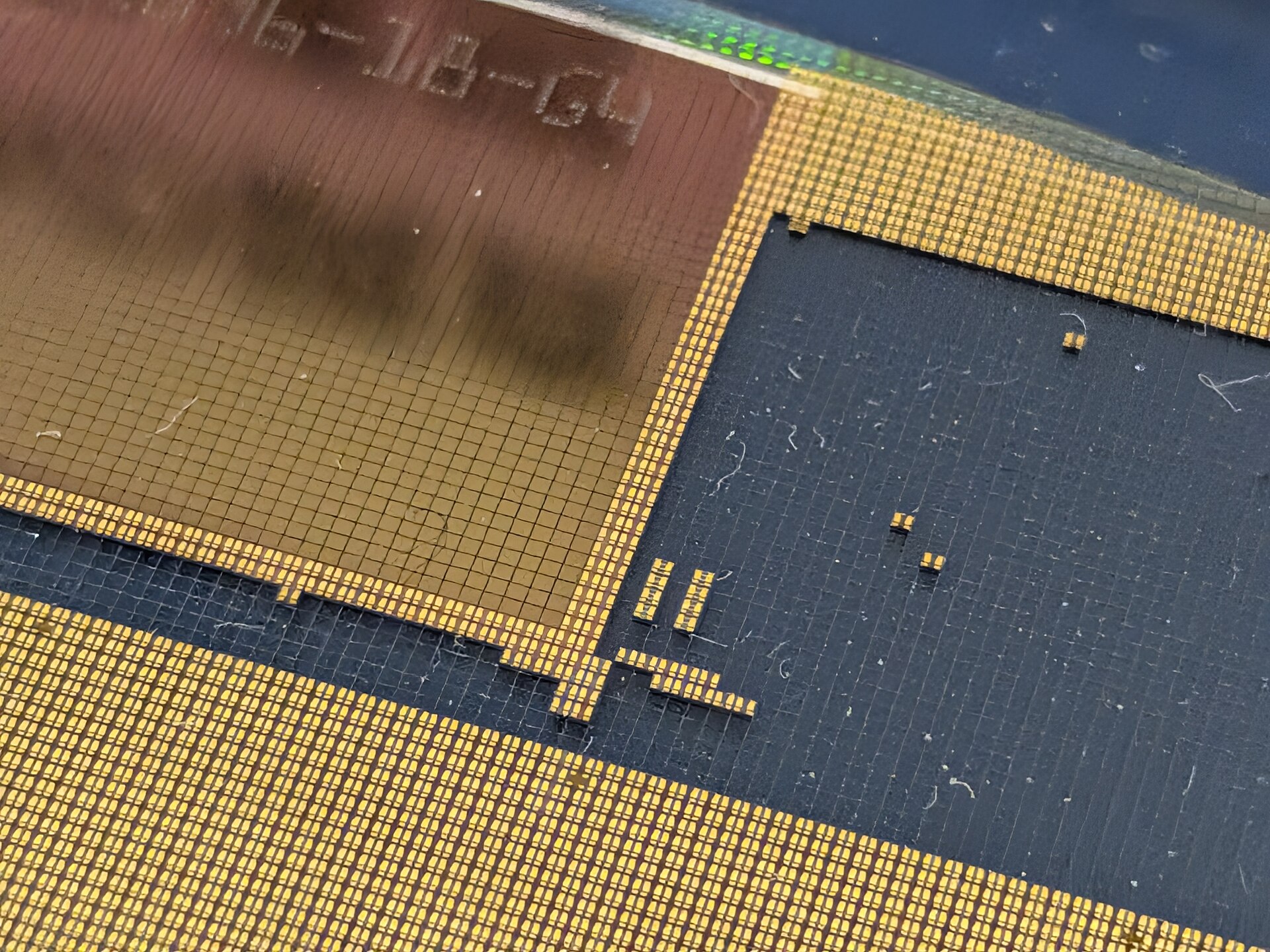
Image: Syced via Wikimedia Commons, CC0.
Texas Instruments has spent heavily on 300-millimeter chip factories in Sherman, Richardson and Lehi, Utah, including about $4.6 billion of capital spending in 2025 alone. The third-quarter 2026 results, released October 21, 2026, show what the Dallas company’s income statement looks like when demand returns and the heaviest construction bills are behind it. Revenue rose by more than a quarter, operating profit rose by nearly three-quarters and trailing 12-month free cash flow more than tripled. All figures below are as of November 20, 2026.
What Did Texas Instruments Report for the Third Quarter of 2026?
Revenue was $6,055 million, up 28 percent from $4,742 million in the third quarter of 2025. Chief Executive Haviv Ilan said in the release that revenue also rose 11 percent from the second quarter, with broad growth across industrial, automotive and data center customers.
Profit grew far faster than sales. Operating profit was $2,874 million, up 73 percent from $1,663 million. That works out to an operating margin of about 47.5 percent, compared with about 35.1 percent a year earlier. Net income was $2,425 million, up 78 percent from $1,364 million, and diluted earnings per share were $2.62, up 77 percent from $1.48. The company said the per-share figure included a 1-cent reduction that was not in its original guidance.
Gross profit was $3,887 million, or about 64.2 percent of revenue, up from $2,723 million, or about 57.4 percent, a year earlier. Operating costs barely moved by comparison. Research and development spending was $530 million, against $518 million a year earlier, and selling, general and administrative expense was $476 million, against $457 million. The year-ago quarter also carried $85 million of restructuring and other charges that did not recur, while this quarter included $7 million of acquisition charges.
| Measure | Q3 2026 | Q3 2025 | Change |
|---|---|---|---|
| Revenue | $6,055 million | $4,742 million | +28% |
| Gross profit | $3,887 million | $2,723 million | +43% |
| Operating profit | $2,874 million | $1,663 million | +73% |
| Net income | $2,425 million | $1,364 million | +78% |
| Diluted earnings per share | $2.62 | $1.48 | +77% |
| Cash flow from operations | $3,419 million | $2,190 million | +56% |
| Capital expenditures | $463 million | $1,197 million | -61% |
Source: Texas Instruments third quarter 2026 earnings release. Gross profit, cash flow and capital expenditure percentage changes are calculated from the reported figures.
Which Texas Instruments Businesses Grew Fastest?
Analog, the company’s core business of chips that manage power and translate real-world signals, did most of the work. Analog revenue was $4,911 million, up 32 percent from $3,729 million, and the segment’s operating profit rose 69 percent to $2,505 million. Analog accounted for about 81 percent of total revenue.
Embedded Processing, which sells microcontrollers and processors, posted revenue of $858 million, up 21 percent from $709 million. Its operating profit more than doubled, rising 110 percent to $227 million from $108 million. The Other segment, which holds the company’s remaining businesses, saw revenue slip 6 percent to $286 million.
| Segment | Revenue | Change | Operating profit | Change |
|---|---|---|---|---|
| Analog | $4,911 million | +32% | $2,505 million | +69% |
| Embedded Processing | $858 million | +21% | $227 million | +110% |
| Other | $286 million | -6% | $142 million | +106% |
How much of the growth came from data centers?
The earnings release names industrial, automotive and data center as the growth drivers without attaching percentages. An analysis of the earnings call by research firm Futurum Group, published November 2, 2026, reported that data center revenue rose about 95 percent from a year earlier and about 20 percent from the prior quarter, reaching roughly 13 percent of total revenue. Applying that share to the quarter’s revenue implies data center sales of roughly $790 million, a calculation and not a company-reported figure.
The same analysis reported that industrial revenue rose more than 40 percent from a year earlier and returned to the peak level last seen in the third quarter of 2022, while automotive revenue grew at a mid-teens percentage rate. Both markets grew about 10 percent from the second quarter. Texas Instruments reorganized its end-market reporting earlier in 2026 to break out data center as its own category, according to a MarketBeat report on the company’s February 2026 capital management call. On that call, Ilan said industrial, automotive and data center together made up about 75 percent of 2025 revenue, up from about 43 percent in 2013.
How Much Cash Is Texas Instruments Generating?
Cash flow is where the change is most visible. For the 12 months ended September 30, 2026, cash flow from operations was $9,896 million, up 43 percent from $6,897 million, and equal to 47.7 percent of revenue. Capital expenditures over the same 12 months fell to $2,578 million from $4,817 million.
Free cash flow, which the company defines as operating cash flow minus capital expenditures plus proceeds from CHIPS and Science Act incentives, was $8,422 million for the trailing 12 months. That is up 249 percent from $2,415 million a year earlier, and it represents 40.6 percent of revenue, compared with 14.0 percent. In the third quarter alone, free cash flow was $2,956 million.
Federal incentives are part of that picture. The company reported $1,104 million of CHIPS Act incentive proceeds over the trailing 12 months, up from $335 million. Separately, it used $79 million of investment tax credits to reduce taxes payable in the third quarter. According to the MarketBeat report on the February call, the investment tax credit rate for chip manufacturing now stands at 35 percent, up from 25 percent.
What is the company returning to shareholders?
Texas Instruments returned $5,810 million to shareholders over the trailing 12 months. Dividends accounted for $5,174 million, up 5 percent, and stock repurchases for $636 million, down from $1,611 million. In the third quarter the company paid $1,298 million in dividends and bought back $48 million of stock. Futurum Group reported that the company raised its quarterly dividend 7 percent to $1.52 per share, its 23rd consecutive annual increase.
The balance sheet strengthened as well. Cash and short-term investments totaled $8,142 million at September 30, 2026, up from $5,186 million a year earlier. Total debt was $13,555 million, down from $14,046 million. Inventory was $4,672 million, down from $4,829 million, which Futurum Group put at 194 days. Management’s stated target range is 150 to 250 days, according to the February call report.
What Do the Results Mean for the Sherman and Richardson Fabs?
The company’s North Texas factories are central to the margin story. Texas Instruments has been moving production onto 300-millimeter wafers made in its own plants, which yield more chips per wafer than older 200-millimeter lines. The February call report laid out the status of each site. At Sherman, north of Dallas, the first factory, known as SM1, had a completed clean room with production underway and ramping in step with demand, and the shell of a second factory, SM2, was complete. In Richardson, the transfer of products from older 150-millimeter lines into the RFAB2 plant was finished, and RFAB2 was expected to more than double the capacity of the neighboring RFAB1.
At Lehi, Utah, the company was adding 45-nanometer to 65-nanometer products and bringing work in from outside foundries. Futurum Group’s analysis said that shift is lifting Embedded Processing gross margin by a couple of points each quarter and by about 10 points from a year earlier, and that the shell of a second Lehi factory is nearing completion. It also noted early ramps of application-specific power products at Sherman.
The company’s long-range targets, as reported from the February call, are to source more than 95 percent of its wafers internally and to run more than 80 percent of production on 300-millimeter wafers by 2030.
How much is Texas Instruments still spending on factories?
Much less than at the peak. Capital spending was about $4.6 billion in 2025, and management guided 2026 spending to a range of $2 billion to $3 billion, according to the February call report. Futurum Group reported that 2026 spending is likely to land toward the upper end of that range if equipment deliveries arrive on time, and that the company plans to detail 2027 spending in February 2027. Third-quarter capital expenditures of $463 million compare with $1,197 million a year earlier.
The earlier spending is now showing up as depreciation. Third-quarter depreciation was $555 million, up from $497 million, and net property, plant and equipment stood at $11,833 million.
What Is Texas Instruments’ Outlook for the Fourth Quarter?
The company guided fourth-quarter 2026 revenue to a range of $5.80 billion to $6.30 billion and earnings per share to a range of $2.45 to $2.79. The midpoint of the revenue range, $6.05 billion, is roughly flat with the third quarter. Futurum Group reported that management expects an effective tax rate of about 13 percent in the fourth quarter and 13 to 14 percent in 2027.
Pricing has turned in the company’s favor. Futurum Group’s analysis said pricing was flat from a year earlier in the first half of 2026 and rose in the second half, mainly in Analog. It also reported that lead times for back-end manufacturing tools are stretching and outside assembly capacity is tightening, and that a new assembly and test site in Malaysia is ramping.
What about the Silicon Labs acquisition?
The $7 million of acquisition charges in the quarter relates to a pending deal. According to the February call report, Texas Instruments expects its acquisition of Silicon Labs to close in the first half of 2027, funded with cash and pre-arranged debt. The earnings release itself does not give further detail on the transaction.
| Headquarters | Dallas, Texas |
| Chief executive | Haviv Ilan |
| Trailing 12-month revenue | About $20.8 billion |
| Trailing 12-month free cash flow | $8,422 million (40.6% of revenue) |
| Cash returned, trailing 12 months | $5,810 million |
| Cash and short-term investments | $8,142 million |
| Total debt | $13,555 million |
| Q4 2026 revenue guidance | $5.80 billion to $6.30 billion |
| North Texas 300mm sites | Sherman (SM1, SM2), Richardson (RFAB1, RFAB2) |
Brian’s Take
As a former investment manager and analyst, I find the pattern in these numbers a familiar one for capital-intensive businesses. A company builds ahead of demand, takes the criticism while free cash flow shrinks, and then the cycle turns. Revenue here grew 28 percent while operating profit grew 73 percent. That gap is operating leverage, and it is the payoff for building capacity ahead of demand.
What matters for North Texas is that much of that capacity sits here. Capital spending dropped from about $4.6 billion in 2025 to a guided $2 billion to $3 billion this year, yet the Sherman and Richardson plants are the ones now ramping. The data center figure, about 13 percent of revenue and nearly doubling by one analyst’s read, tells me the customer mix is shifting faster than most people assume for a company known for industrial and automotive chips.
I would keep an eye on two things in these facts. Inventory is still 194 days, and fourth-quarter guidance is flat at the midpoint. Neither is a red flag on its own, but together they are a reminder that this is still a cyclical business.
Frequently Asked Questions
How much revenue did Texas Instruments report in the third quarter of 2026?
$6,055 million, up 28 percent from $4,742 million a year earlier and up 11 percent from the second quarter of 2026.
What was Texas Instruments’ profit?
Net income was $2,425 million, up 78 percent, and diluted earnings per share were $2.62, up 77 percent from $1.48.
Where is Texas Instruments headquartered?
Dallas, Texas. Its newest 300-millimeter chip factories in the state are in Sherman and Richardson.
What is Texas Instruments’ fourth-quarter guidance?
Revenue of $5.80 billion to $6.30 billion and earnings per share of $2.45 to $2.79.
How much free cash flow does the company generate?
$8,422 million over the 12 months ended September 30, 2026, equal to 40.6 percent of revenue, up from $2,415 million a year earlier.
How much is Texas Instruments spending on capital projects in 2026?
Management guided to $2 billion to $3 billion, down from about $4.6 billion in 2025, according to a report on its February 2026 capital management call.
Sources and Further Reading
- TI Reports Third Quarter 2026 Financial Results and Shareholder Returns, Texas Instruments (via Investing News Network)
- Texas Instruments Q3 FY 2026 Earnings Beat as Data Center Sales Nearly Double, Futurum Group
- Texas Instruments Slashes 2026 Capex, MarketBeat (via Yahoo Finance)
- Texas Instruments Q3 2026: 300mm Bet Pays Off With 73% Operating Income Jump, 24/7 Wall St.
- Texas Instruments Q3 2026 Earnings Call page, Fortune