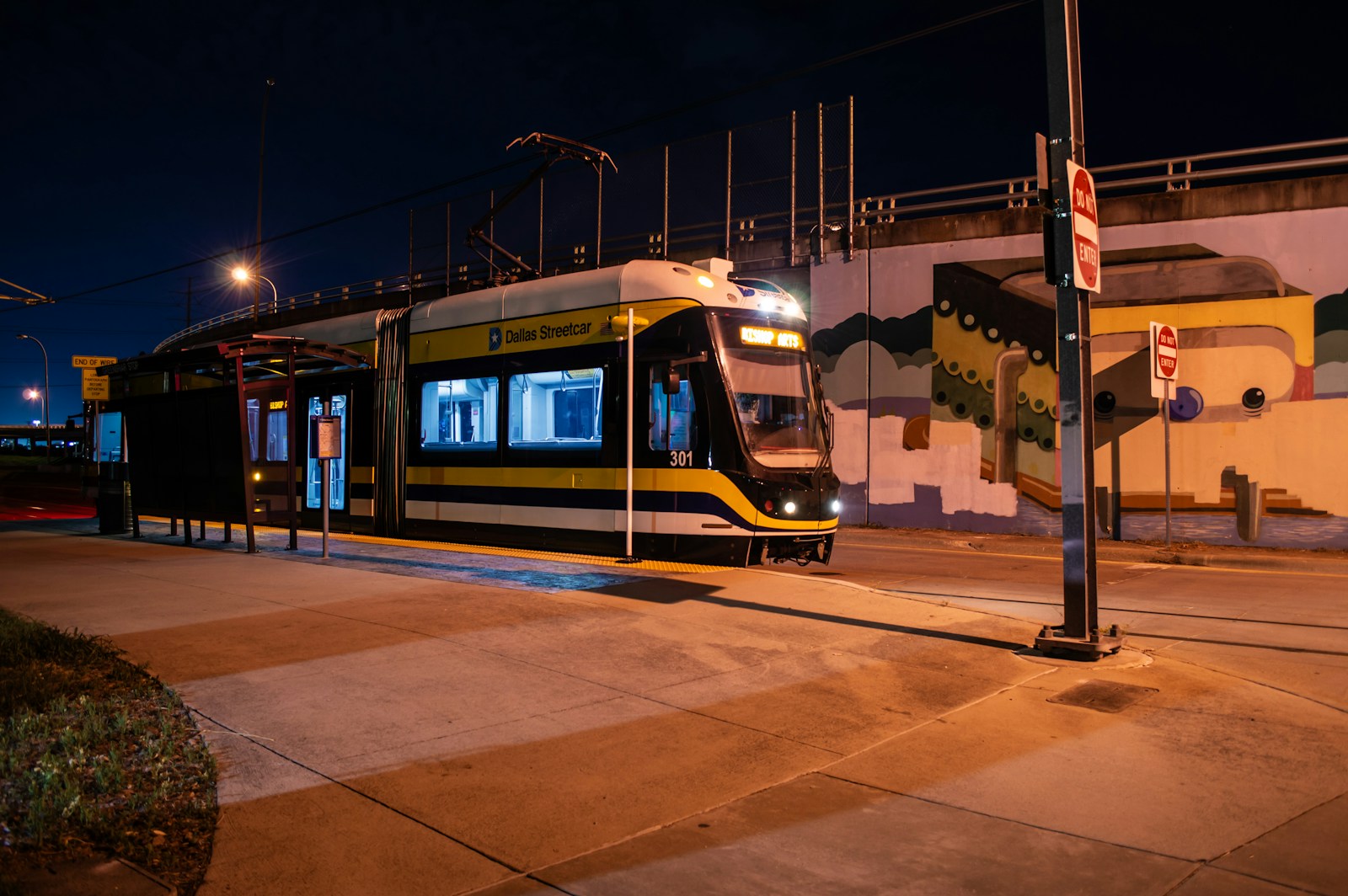
Generic image of a rail vehicle passing a station in Dallas. Photo: Alek Burt / Unsplash (Unsplash License).
Quick Answer: Dallas Area Rapid Transit enters late 2026 with 12 member cities, a $1.84 billion fiscal 2027 budget approved on September 22, and a sales tax base that is growing again: the Texas Comptroller sent the agency $89.9 million in November, up 14 percent from a year earlier. Five of the six cities that called withdrawal elections stayed, Highland Park left, and the price of keeping the others is a revenue-sharing program worth about $421.5 million through fiscal 2031. Ridership is the weak spot, with agency leadership warning of a slide from roughly 55 million trips to 52 million.
Where does DART stand in November 2026?
A year ago, six of DART’s 13 member cities had put the agency’s future on the ballot. As of November 19, 2026, the system is smaller by one town, operating under a new revenue-sharing deal and a budget with no service cuts, and preparing to ask the Texas Legislature to rewrite how its board is built. DART’s fiscal year starts October 1, so fiscal 2027 is in its second month.
| Key fact | Figure | Period or date |
|---|---|---|
| Member cities | 12 (13 before Highland Park left) | Since May 2026 |
| Total budget | $1,842.6 million | Fiscal 2027 |
| Budgeted sales tax revenue | $965.7 million | Fiscal 2027 |
| Comptroller allocation | $89.9 million, up 13.96 percent | November 2026 |
| Total system ridership | 55.5 million trips | Fiscal 2025 |
| Revenue returned to cities | About $421.5 million | Fiscal 2026 to 2031 |
How much sales tax is DART collecting?
DART is funded mainly by a one-cent sales tax collected in its member cities, a levy voters approved in 1983. Texas Comptroller allocation records show the Dallas transit authority received $89.9 million in November 2026, compared with $78.9 million in November 2025, a gain of 13.96 percent. October’s payment was $79.1 million, up 8.03 percent, after a September payment of $78.0 million that was down 1.32 percent from the prior year.
Through 11 months of calendar 2026, allocations total $874.6 million, up 5.86 percent from $826.2 million at the same point in 2025. For all of calendar 2025, the Comptroller sent DART $905.7 million.
How does that compare with the rest of Texas?
Statewide, the Comptroller distributed $1.4 billion in local allocations in November, up 14.6 percent, largely reflecting September sales. Transit systems as a group received $301.1 million, up 16.1 percent for the month and 8.1 percent year to date. DART took roughly 30 percent of the transit total, and its 5.86 percent year-to-date growth trails the group’s pace.
Which cities pay the most?
DART’s reference book breaks down fiscal 2025 receipts of $900.4 million by city. Dallas generated $435.9 million, about 48 percent. Plano contributed $127.4 million and Irving $113.3 million. Together those three cities supplied about 75 percent of the total. Richardson ($54.0 million), Garland ($50.7 million), Carrollton ($50.4 million), Farmers Branch ($24.1 million) and Addison ($17.0 million) followed. Highland Park, which has since left, accounted for $9.1 million, or about 1 percent.
What is in the fiscal 2027 budget?
The board approved the fiscal 2027 budget and a companion 20-year financial plan on September 22, 2026. KERA reported that two directors, representing Plano and a seat shared by Carrollton and Irving, voted no. The resolution totals $1,842,570,010, an increase of $30.6 million, or 1.7 percent, over fiscal 2026.
| Category | FY2026 budget | FY2027 budget | Change |
|---|---|---|---|
| Operating | $757.9 million | $797.7 million | Up 5.3 percent |
| Capital and non-operating | $830.7 million | $817.5 million | Down 1.6 percent |
| Debt service | $223.4 million | $227.4 million | Up 1.8 percent |
| Total | $1,812.0 million | $1,842.6 million | Up 1.7 percent |
| Sales tax revenue | $937.5 million | $965.7 million | Up 3.0 percent |
| Total revenue | $1,385.2 million | $1,442.5 million | Up 4.1 percent |
Where does the money come from?
Sales tax supplies about 67 percent of the $1,442.5 million in budgeted revenue. Federal formula funds add $152.1 million and discretionary federal grants $181.1 million. Operating revenue, the line that includes fares, is budgeted at $58.1 million, a small fraction of the $797.7 million operating budget.
Revenue does not cover the full budget. Borrowing closes the gap: DART plans $576 million of debt in fiscal 2027, tied in board materials to the Silver Line and bus purchases, and $1.8 billion over five years. The plan assumes sales tax grows 3.0 percent annually through fiscal 2030.
Where does it go?
By mode, bus service takes $364.5 million of the operating budget, light rail $221.4 million, commuter rail $92.9 million, paratransit $69.2 million and the GoLink on-demand service $47.1 million. The largest drivers of operating growth are salaries and benefits ($10.1 million), paratransit and GoLink ($9.4 million) and police and security ($8.3 million). Budgeted headcount rises by about 40 positions from 3,693. The five-year capital program totals $3.2 billion, with $1.6 billion aimed at light rail.
The budget contains no service changes. Light rail stays at 20-minute frequency, the Silver Line at 30 minutes during peak periods and 60 minutes otherwise, and GoLink covers 32 zones.
What happened in the 2026 withdrawal elections?
Addison, Farmers Branch, Highland Park, Irving, Plano and University Park all scheduled May 2 elections on leaving DART, driven by concerns about the return on their sales tax contributions. In late February, Plano, Farmers Branch and Irving cancelled their votes after DART approved a revenue-sharing arrangement called the General Mobility Program. Irving’s council voted 7-2 to rescind its election.
Three elections went ahead. About 70 percent of Addison voters and 54 percent of University Park voters chose to remain. In Highland Park, about 70 percent voted to leave, making it the first city to exit since Coppell and Flower Mound in 1989. DART stopped serving the town on May 14. Under state law, a city can hold a withdrawal election only once every six years.
What does Highland Park’s exit cost?
DART has projected a loss of about $270 million in sales tax over 20 years. The town does not stop paying right away: the one-cent tax continues to be collected there until Highland Park’s share of DART’s obligations is paid off. That amount had not been disclosed as of early November, according to the Dallas Morning News, and the DART board’s October 27 agenda included hiring outside counsel to help determine the withdrawn city’s total financial obligation.
What did DART give up to keep the other cities?
The General Mobility Program returns a share of sales tax to member cities for their own transportation projects. The share starts at 5 percent in fiscal 2026 and rises one point a year to 10 percent in fiscal 2031. DART funds up to 7.5 percent, and the Regional Transportation Council authorized $75 million on February 12, 2026, to cover the rest.
An October 19 briefing to a Dallas City Council committee put the six-year total at about $421.5 million: $346.8 million from DART and $74.7 million from the regional council. Annual payments grow from $41.0 million in fiscal 2026 to $52.2 million in fiscal 2027 and $101.6 million in fiscal 2031. Dallas received its first disbursement of $21.2 million on October 1 and is estimated to collect about $211 million over the program. Addison, Highland Park and University Park forfeited participation by holding elections.
The board chair said at the September vote that the program is fully funded in this budget. The longer view is less settled: the Dallas briefing listed no budgeted allocations after fiscal 2027.
How is governance changing?
The 15-seat board is apportioned by population, and Dallas holds a majority. The framework cities agreed to in February would end that: Dallas would keep at least seven seats and 40 to 50 percent of the vote, every city would get its own seat, and no single city would control a majority. KERA reported the plan would enlarge the board to more than 20 members. None of it takes effect without an amendment to Chapter 452 of the Texas Transportation Code. The board approved that change as a legislative priority on February 24, and its agenda for the 90th Texas Legislature also opposes bills that would substantially affect the one-cent tax or DART’s debt.
Leadership turned over as well. David Leininger, a former DART chief financial officer, served as interim chief from May. In July the board selected Nathaniel Ford Sr., head of the Jacksonville Transportation Authority, on a 9-4 vote; he was scheduled to start October 26 on a three-year contract.
Is ridership recovering?
Not yet. DART’s reference book reports 55.5 million trips in fiscal 2025, including 28.6 million on buses, 22.0 million on light rail, 2.1 million on GoLink and 1.27 million on the Trinity Railway Express, with average weekday ridership of 170,372.
Fiscal 2026 moved in the wrong direction. First-quarter bus ridership fell 5.6 percent and light rail 7.1 percent from a year earlier, while GoLink rose 14.5 percent. In the third quarter, bus ridership was down 7.1 percent, light rail down 1.8 percent and GoLink up 7.6 percent. Dallas briefing materials linked the bus decline partly to the frequency reductions in a February 2026 service change. In September, Leininger told a regional infrastructure conference that ridership would slip from about 55 million trips this year to 52 million next year without a change of course, the Dallas Morning News reported.
What does this mean for employers and development?
For employers, the main near-term fact is stability: 12 cities remain in the service area, and fiscal 2027 brings no further service reductions. The busiest GoLink zone in the third quarter was the Inland Port in southern Dallas, a warehouse and logistics district, with 675 average weekday riders. The 26-mile Silver Line, which opened in October 2025, links Plano, Richardson, Addison and Carrollton to DFW Airport.
For developers, DART is turning station parking into housing. The $107.1 million Palladium at Buckner Station project replaces 391 surplus spaces with 304 apartments, 244 of them reserved for households at 60 percent of area median income. A 16-acre project is under way at Mockingbird Station, and DART issued a request for qualifications on October 5 for an 18-acre site at Westmoreland Station. Dallas approved a station-area tax increment agreement with DART on September 23, and Irving has executed one.
The risks are in the out years. Discretionary federal funding is projected to drop from $181.1 million in fiscal 2027 to $81.9 million in fiscal 2028 and $15.1 million in fiscal 2029. City payments nearly double by fiscal 2031 while the sales tax forecast grows 3 percent a year.
Brian’s Take
I read these numbers as a truce, not a settlement. DART kept Plano, Irving and Farmers Branch by agreeing to hand back a rising share of its main revenue source, and a City of Dallas briefing shows no budgeted allocations after fiscal 2027. A program that grows from $41 million to more than $100 million a year, sitting on top of $576 million in new borrowing and falling federal grants, has to be paid for somewhere.
What stands out to me as a former analyst is the gap between the revenue line and the ridership line. Sales tax allocations are up nearly 6 percent this year, which points to healthy consumer spending in these cities. Trips are heading the other way. An agency can live with that for a while because the tax, not the farebox, pays the bills, but cities questioning what they get for their contributions is what put six of them on the ballot in the first place.
For Texas business, I think the governance bill is the item to watch. Employers and developers making decisions around stations need to know who controls the board and whether the one-cent tax stays intact. Until the Legislature acts, that question is open, and cities can hold withdrawal elections again in six years.
Frequently Asked Questions
How many cities are in DART now?
Twelve: Addison, Carrollton, Cockrell Hill, Dallas, Farmers Branch, Garland, Glenn Heights, Irving, Plano, Richardson, Rowlett and University Park. Highland Park withdrew after its May 2, 2026 election.
How big is DART’s fiscal 2027 budget?
The board approved $1,842.6 million on September 22, 2026: $797.7 million for operations, $817.5 million for capital and non-operating items, and $227.4 million for debt service.
How much sales tax does DART receive?
DART budgeted $965.7 million for fiscal 2027. Texas Comptroller records show $874.6 million allocated in the first 11 months of calendar 2026, up 5.86 percent from the same period of 2025.
Did Plano and Irving leave DART?
No. Plano, Irving and Farmers Branch cancelled their withdrawal elections in February 2026 after DART approved the General Mobility Program. Addison and University Park voters chose to stay.
What is the General Mobility Program?
It returns a share of sales tax to participating cities for local transportation projects, rising from 5 percent in fiscal 2026 to 10 percent in fiscal 2031, an estimated $421.5 million in total.
Sources and Further Reading
- FY 2027 Annual Budget and 20-Year Financial Plan, board presentation and resolution, September 22, 2026 – Dallas Area Rapid Transit
- Proposed FY 2027 Annual Budget and 20-Year Financial Plan, August 25, 2026 – Dallas Area Rapid Transit
- Board of Directors agendas, September 22 and October 27, 2026 – Dallas Area Rapid Transit
- 2026 DART Reference Book – Dallas Area Rapid Transit
- Sales Tax Allocation: County, MTA, SPD dataset – Texas Comptroller of Public Accounts
- November 2026 local sales tax allocations release – Texas Comptroller of Public Accounts
- Quarterly Dallas Area Rapid Transit Update, May 18, 2026, and October 19, 2026 – City of Dallas
- DART passes new budget as riders urge for more funding sources – KERA News
- Irving cancels DART withdrawal election in 7-2 city council vote – KERA News
- Votes are in: Who stays and who goes within DART’s service network – Mass Transit
- Six months after Highland Park left DART, transit riders adjust to new service – The Dallas Morning News
- North Texas transit faces a ridership problem as region keeps growing – The Dallas Morning News
- Dallas Area Rapid Transit names new president, CEO – Cowcatcher Magazine