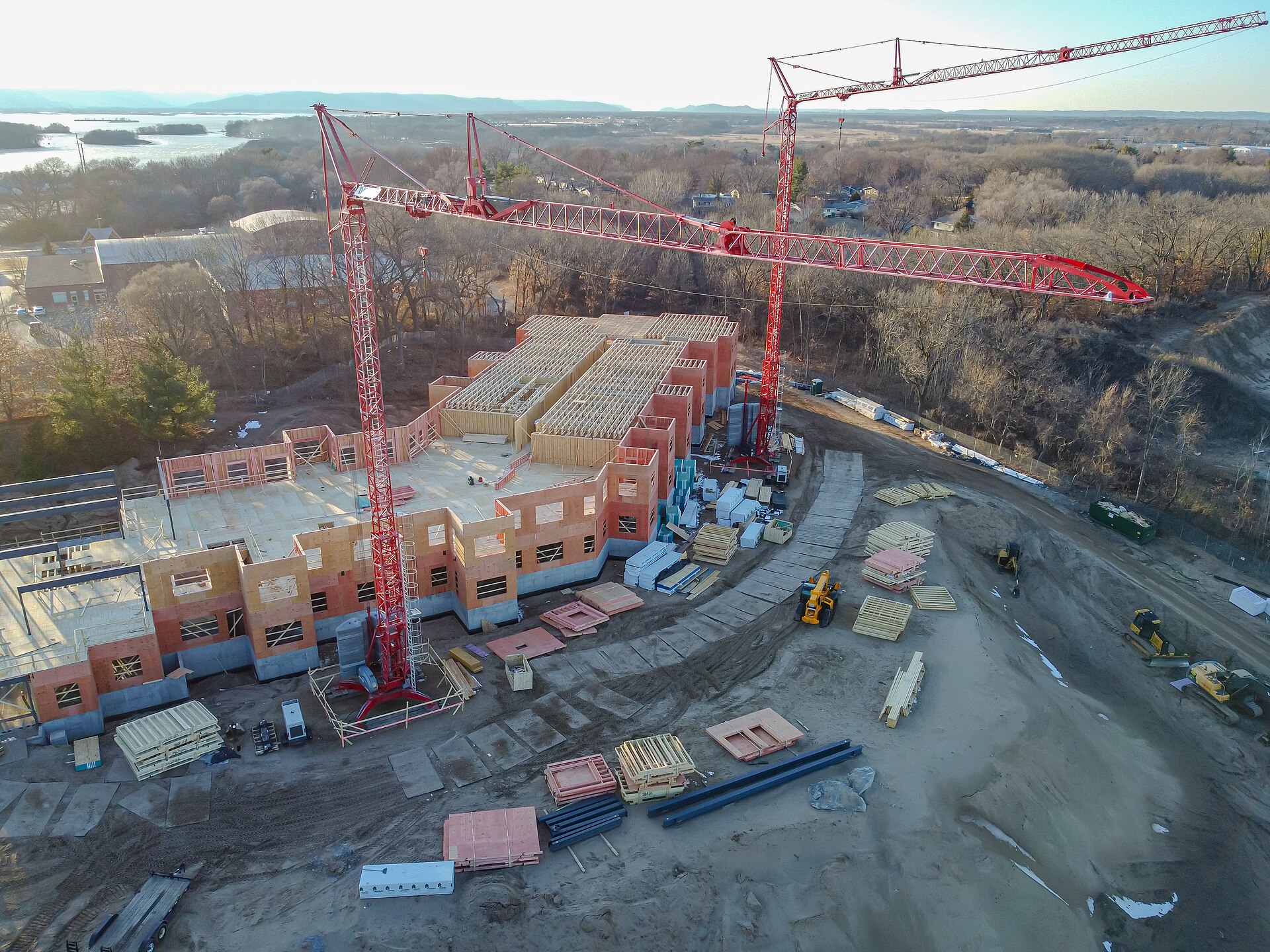
Aerial view of a tower crane at a construction site. Photo: Wikideas1 via Wikimedia Commons, CC0.
Quick Answer: Dallas-based Jacobs Solutions reported fiscal 2026 results on November 23, 2026, with adjusted earnings of $7.32 per share, up 19.6%, and a backlog of $28.7 billion, up 24.2% from a year earlier. Fourth-quarter adjusted earnings were $2.20 per share. The engineering firm forecast fiscal 2027 adjusted earnings of $8.05 to $8.45 per share.
Jacobs Solutions, the Dallas-headquartered engineering and consulting company, closed its fiscal year with results at or above the top of the targets it set twelve months ago. The company reported on November 23, 2026 for the quarter and year that ended October 2, 2026, and paired the numbers with a fiscal 2027 outlook that calls for another year of double-digit earnings growth at the midpoint.
The figures below come from the earnings release Jacobs filed with the U.S. Securities and Exchange Commission, the company’s prior-year release and its 2026 contract announcements. Jacobs trades on the New York Stock Exchange under the ticker J. All figures are as of November 25, 2026.
What Did Jacobs Report for the Fourth Quarter?
Gross revenue for the fiscal fourth quarter was $4,712.3 million, up 49.4% from $3,154.6 million in the same quarter of fiscal 2025. Adjusted net revenue, which strips out pass-through costs that Jacobs bills to clients on behalf of subcontractors and suppliers, was $2,594.8 million, up 15.7% from $2,242.2 million. The gap between the two growth rates indicates that pass-through work grew much faster than the company’s own fee-based revenue.
Net earnings from continuing operations under generally accepted accounting principles (GAAP) were $165.9 million, up 20.2% from $138.0 million. GAAP diluted earnings per share from continuing operations were $1.40, up 33.3% from $1.05. Adjusted earnings per share were $2.20, up 25.7% from $1.75.
Adjusted EBITDA, a measure of operating profit before interest, taxes, depreciation and amortization, was $420.8 million, up 30.1%. The adjusted EBITDA margin was 16.2%, compared with 14.4% a year earlier. GAAP operating profit was $331.6 million on gross profit of $917.4 million. The effective tax rate was 42.7% on a GAAP basis and 26.3% on an adjusted basis.
How did the quarter compare with expectations?
Ahead of the report, a preview published by Earnings Whispers put the consensus estimate for adjusted earnings at $2.14 per share. The reported $2.20 was above that figure. Post-earnings analyst commentary and the stock’s reaction were not available in the sources reviewed for this article.
| Fourth quarter | FY2026 | FY2025 | Change |
|---|---|---|---|
| Gross revenue | $4,712.3M | $3,154.6M | +49.4% |
| Adjusted net revenue | $2,594.8M | $2,242.2M | +15.7% |
| GAAP net earnings, continuing operations | $165.9M | $138.0M | +20.2% |
| GAAP diluted EPS, continuing operations | $1.40 | $1.05 | +33.3% |
| Adjusted EPS | $2.20 | $1.75 | +25.7% |
| Adjusted EBITDA margin | 16.2% | 14.4% | +1.8 points |
Source: Jacobs Solutions fiscal fourth-quarter 2026 earnings release, filed November 23, 2026.
How Did Jacobs Perform for the Full Fiscal Year?
For fiscal 2026, gross revenue was $15,776.9 million, up 31.1% from $12,029.8 million. Adjusted net revenue was $9,592.0 million, up 10.3% from $8,695.0 million. Adjusted earnings per share were $7.32, up 19.6% from $6.12. Adjusted EBITDA was $1,417.3 million, up 17.5%, and the margin widened to 14.8% from 13.9%.
On a GAAP basis the picture is more mixed. Net earnings from continuing operations rose 23.0% to $385.2 million, and diluted earnings per share from continuing operations rose 30.6% to $3.37 from $2.58. But GAAP operating profit fell to $769.7 million from $863.6 million, because of charges tied largely to the company’s purchase of the rest of PA Consulting. The GAAP effective tax rate for the year was 42.2%, against 25.9% on an adjusted basis.
Did Jacobs hit its own targets?
It met or exceeded them. In November 2025 the company guided to fiscal 2026 adjusted earnings of $6.90 to $7.30 per share, an adjusted EBITDA margin of 14.4% to 14.7% and adjusted net revenue growth of 6% to 10%. The reported $7.32, 14.8% and 10.3% each landed above the top of those original ranges. Jacobs had since narrowed its earnings range to $7.20 to $7.30 and its margin range to 14.7% to 14.8%, according to the Earnings Whispers preview. Against those updated figures, earnings finished above the range and the margin finished at the top.
| Full year | FY2026 | FY2025 | Change |
|---|---|---|---|
| Gross revenue | $15,776.9M | $12,029.8M | +31.1% |
| Adjusted net revenue | $9,592.0M | $8,695.0M | +10.3% |
| GAAP net earnings, continuing operations | $385.2M | $313.3M | +23.0% |
| GAAP operating profit | $769.7M | $863.6M | Lower |
| Adjusted EPS | $7.32 | $6.12 | +19.6% |
| Backlog at year end | $28.7B | $23.1B | +24.2% |
Source: Jacobs Solutions fiscal 2026 and fiscal 2025 earnings releases.
How Large Is Jacobs’ Backlog?
Backlog, the value of contracted work not yet performed, stood at $28.7 billion at fiscal year end, up 24.2% from $23.1 billion a year earlier. Nearly all of it, $28,178 million, sits in the Infrastructure and Advanced Facilities segment, up from $22,649 million. PA Consulting accounted for $474 million, up from $415 million.
The book-to-bill ratio, which compares new awards with revenue recognized, was 1.4 times for the full year on gross revenue and 1.2 times on adjusted net revenue. A ratio above 1.0 means the company signed more work than it completed. In the fourth quarter alone, the ratio was 1.0 times on gross revenue and 1.1 times on adjusted net revenue, a slower pace of additions than the full-year figure.
Which Jacobs Businesses Are Growing Fastest?
Jacobs reports two segments. Infrastructure and Advanced Facilities is the engineering, design and program management business, and it produces most of the company’s revenue. PA Consulting is the company’s consulting business.
Infrastructure and Advanced Facilities
The segment’s fourth-quarter gross revenue was $4,347.4 million, up from $2,836.2 million. Adjusted net revenue was $2,229.9 million, up from $1,923.8 million, an increase of about 16%. Segment operating profit rose to $313.3 million from $254.0 million, about 23% higher.
For the year, segment gross revenue was $14,369.5 million against $10,764.2 million, adjusted net revenue was $8,184.6 million against $7,429.4 million, and operating profit was $1,021.4 million against $903.5 million, a gain of about 13%. Jacobs said growth was led by five end markets: life sciences, semiconductors, energy and power, water, and data centers.
PA Consulting
PA Consulting’s fourth-quarter revenue was $364.9 million, up from $318.5 million, a gain of about 15%. Operating profit was $79.9 million, up from $72.0 million. For the year, revenue was $1,407.4 million against $1,265.6 million, up about 11%, and operating profit was $318.3 million against $278.5 million. Jacobs said the unit’s growth rebounded in the fourth quarter, helped by its United Kingdom business and by private-sector work performed alongside the infrastructure segment.
| Segment, full year FY2026 | Revenue measure | Operating profit | Backlog |
|---|---|---|---|
| Infrastructure and Advanced Facilities | $8,184.6M adjusted net revenue | $1,021.4M | $28,178M |
| PA Consulting | $1,407.4M revenue | $318.3M | $474M |
What Did the PA Consulting Buyout Cost?
Jacobs closed its acquisition of the remaining stake in PA Consulting on March 20, 2026, and the transaction runs through much of the year’s GAAP results. Restructuring, transaction and other charges totaled $431.0 million in fiscal 2026, compared with $162.9 million in fiscal 2025. Only $28.1 million of that fell in the fourth quarter, which suggests most of the deal-related cost is now behind the company.
The full-year charges included $237.5 million of subsidiary-level compensation charges. Jacobs recorded a pre-tax expense of $215.3 million when compensation agreements fully vested at closing, and a $20.5 million loss on a foreign exchange forward contract related to the deal. The company spent $924.9 million during the year repurchasing redeemable noncontrolling interests. Amortization of intangible assets was $139.0 million for the year, including $33.5 million in the fourth quarter.
These items explain why GAAP operating profit declined while adjusted measures, which exclude them, rose. Investors comparing the two sets of numbers should note that the adjusted figures are the ones the company uses for its guidance.
How Is Jacobs Using Its Cash?
Cash flow from operations was $622.6 million for fiscal 2026, down from $686.7 million, and $269.9 million in the fourth quarter, down from $383.1 million. Capital expenditures were $94.1 million for the year, up from $79.2 million. Adjusted free cash flow was $870.9 million, up from $607.5 million; the fiscal 2026 figure adds back a $342.4 million payout of PA Consulting transaction proceeds.
The company returned about $887 million to shareholders in fiscal 2026. Share repurchases were $721.1 million, including $107.1 million in the fourth quarter, compared with $754.1 million the prior year. Dividends paid were $165.6 million, up from $153.0 million. Jacobs said it has returned about $2 billion since the start of fiscal 2025, that its diluted share count is down 6% over two years and that its dividend per share is up 24%. Shares outstanding were 116,454,004, compared with 119,081,294 a year earlier.
Debt increased during the year. Long-term debt rose to $3,580.5 million from $2,236.5 million, with net borrowings of $1,351.2 million during the year. Cash and equivalents were $1,257.7 million, little changed from $1,235.4 million. Total assets were $12,023.7 million, including $4,759.9 million of goodwill. Management said net leverage is near its target.
What Is Jacobs Forecasting for Fiscal 2027?
Jacobs issued four targets for the fiscal year now under way. It expects adjusted net revenue of $10.0 billion to $10.35 billion, which would be roughly 4% to 8% above fiscal 2026. It expects an adjusted EBITDA margin of 15.4% to 15.7%, up from 14.8%. It expects adjusted earnings of $8.05 to $8.45 per share; the midpoint of $8.25 would be about 13% above the $7.32 just reported. And it expects a free cash flow margin of 8.5% to 9.5%.
| Fiscal 2027 outlook | Range | FY2026 actual |
|---|---|---|
| Adjusted net revenue | $10.0B to $10.35B | $9.59B |
| Adjusted EBITDA margin | 15.4% to 15.7% | 14.8% |
| Adjusted EPS | $8.05 to $8.45 | $7.32 |
| Free cash flow margin | 8.5% to 9.5% | n/a |
Source: Jacobs Solutions fiscal fourth-quarter 2026 earnings release.
The outlook implies that profit will grow faster than revenue, with margin expansion doing much of the work. In the release, Chief Executive Bob Pragada said artificial intelligence is accelerating innovation in clients’ businesses, and Chief Financial Officer Venk Nathamuni said the fourth quarter delivered the highest quarterly operating margin since the company began its current strategy in fiscal 2024.
What Work Is Jacobs Doing in Texas?
Two 2026 contract announcements show the company’s Texas project base, and both line up with the end markets it named as growth leaders.
The Bolivar Roads Gate System
On February 4, 2026, Jacobs announced that the Gulf Coast Protection District had selected it to lead engineering design of the Bolivar Roads Gate System, part of the Coastal Texas Project. The gates would span the strait that links the Gulf to Galveston Bay. Jacobs said nearly $1 billion in state funding backs the project, which is intended to protect more than 6 million residents and about $800 billion in regional assets. The U.S. Army Corps of Engineers and the Texas General Land Office are partners.
The Beacon Point AI data center campus
On May 12, 2026, Jacobs said Hut 8, a Nasdaq-listed company, had awarded it a sole-source engineering, procurement and construction management contract for Beacon Point, a multi-phase AI data center campus in Nueces County. The campus is designed for 1 gigawatt, with initial energization targeted for 2027. The contract value was not disclosed. The award followed Jacobs’ role on Hut 8’s River Bend campus in Louisiana.
The Earnings Whispers preview said work tied directly to the AI buildout had reached 11% of Jacobs’ net revenue. That is a second-hand figure rather than one taken from the earnings release, but it is consistent with the company naming data centers and semiconductors among its fastest-growing markets.
Why Does Jacobs Matter to the Dallas Economy?
Jacobs is a Dallas-based public company with gross revenue of nearly $15.8 billion in the latest year. Company materials from May 2026 described a workforce of approximately 47,000 after the PA Consulting transaction closed, up from nearly 43,000 cited in February. The release does not break out how many of those employees work in North Texas.
Its results also serve as a read on capital spending in the sectors Texas depends on. The firm earns fees at the design and program management stage of water systems, chip plants, power projects and data centers, so its backlog tends to reflect what clients intend to build over the next several years. A backlog that grew 24.2% in a year, with data centers and semiconductors named among the leading markets, is one indicator of where that spending is headed.
Frequently Asked Questions
What were Jacobs’ fiscal 2026 earnings?
Adjusted earnings were $7.32 per share, up 19.6% from $6.12. GAAP diluted earnings from continuing operations were $3.37 per share, up from $2.58.
How big is Jacobs’ backlog?
Backlog was $28.7 billion at fiscal year end, up 24.2% from $23.1 billion a year earlier.
What is Jacobs’ fiscal 2027 guidance?
Adjusted net revenue of $10.0 billion to $10.35 billion, an adjusted EBITDA margin of 15.4% to 15.7%, adjusted earnings of $8.05 to $8.45 per share and a free cash flow margin of 8.5% to 9.5%.
Where is Jacobs headquartered?
Jacobs Solutions is headquartered in Dallas, Texas, and trades on the New York Stock Exchange under the ticker J.
When did Jacobs complete the PA Consulting acquisition?
Jacobs closed its purchase of the remaining stake in PA Consulting on March 20, 2026.
How much did Jacobs return to shareholders?
About $887 million in fiscal 2026, made up of $721.1 million in share repurchases and $165.6 million in dividends.
Sources and Further Reading
- Jacobs Solutions Inc. Form 8-K, Fiscal Fourth Quarter and Fiscal Year 2026 Earnings Release – U.S. Securities and Exchange Commission
- Jacobs Reports Strong Fiscal Fourth Quarter and Fiscal Year 2025 Earnings – Jacobs
- Jacobs to Design One of the World’s Largest Coastal Gate Systems Along Texas Gulf Coast – Jacobs
- Jacobs Awarded EPCM Contract to Deliver Second Hut 8 AI Data Center in Texas – Jacobs
- Jacobs Needs a Strong Fiscal Fourth Quarter as AI Backlog Meets a Higher Bar – Earnings Whispers